App Subscription Pricing 2026: $4.99 vs $9.99 vs $19.99 Math
Most indie developers price their subscription apps by glancing at two competitors and picking a number in between. That single decision — usually made in 30 seconds — sets the ceiling on every dollar the app will ever earn. Get the price right and your conversion rate, lifetime value, and churn all move together in your favor. Get it wrong by even a few dollars and you'll spend a year wondering why your app isn't growing. This is the operator-level guide to App Store subscription pricing in 2026: the real conversion data at each price tier, why $4.99 isn't always cheaper than $9.99 in actual revenue terms, the psychology of $4.99 vs $9.99 vs $19.99, and the exact framework for picking a price you can defend with numbers instead of vibes.
The three price tiers that matter
Subscription pricing on the App Store clusters around three psychological thresholds. Each one creates a fundamentally different user behavior:
- Under $5/month (the impulse tier): Users don't deliberate. The price registers as "small enough not to think about." Common for utilities, light productivity, basic photo tools. Conversion is highest here.
- $5–$9.99/month (the considered tier): Users actively evaluate value. They open your screenshots, read the description, check reviews. Conversion drops noticeably but per-user revenue is higher. Common for fitness, mid-tier productivity, language learning.
- $10–$19.99/month (the premium tier): Users treat it as a real purchase decision. They expect substantial functionality, clear ROI, and often a free trial. Conversion is lowest, but lifetime value per subscriber is dramatically higher.
The pattern most indie developers miss: conversion rate is not the metric to optimize. Revenue per install is. A $19.99 subscription with 1.5% conversion generates more revenue per user than a $4.99 subscription with 4% conversion. Cheap apps aren't always more profitable apps — they're just easier to get to "yes" on.
The 2026 conversion data at each tier
RevenueCat's 2026 subscription benchmarks reveal the real conversion patterns across price tiers. The pattern is consistent across categories:
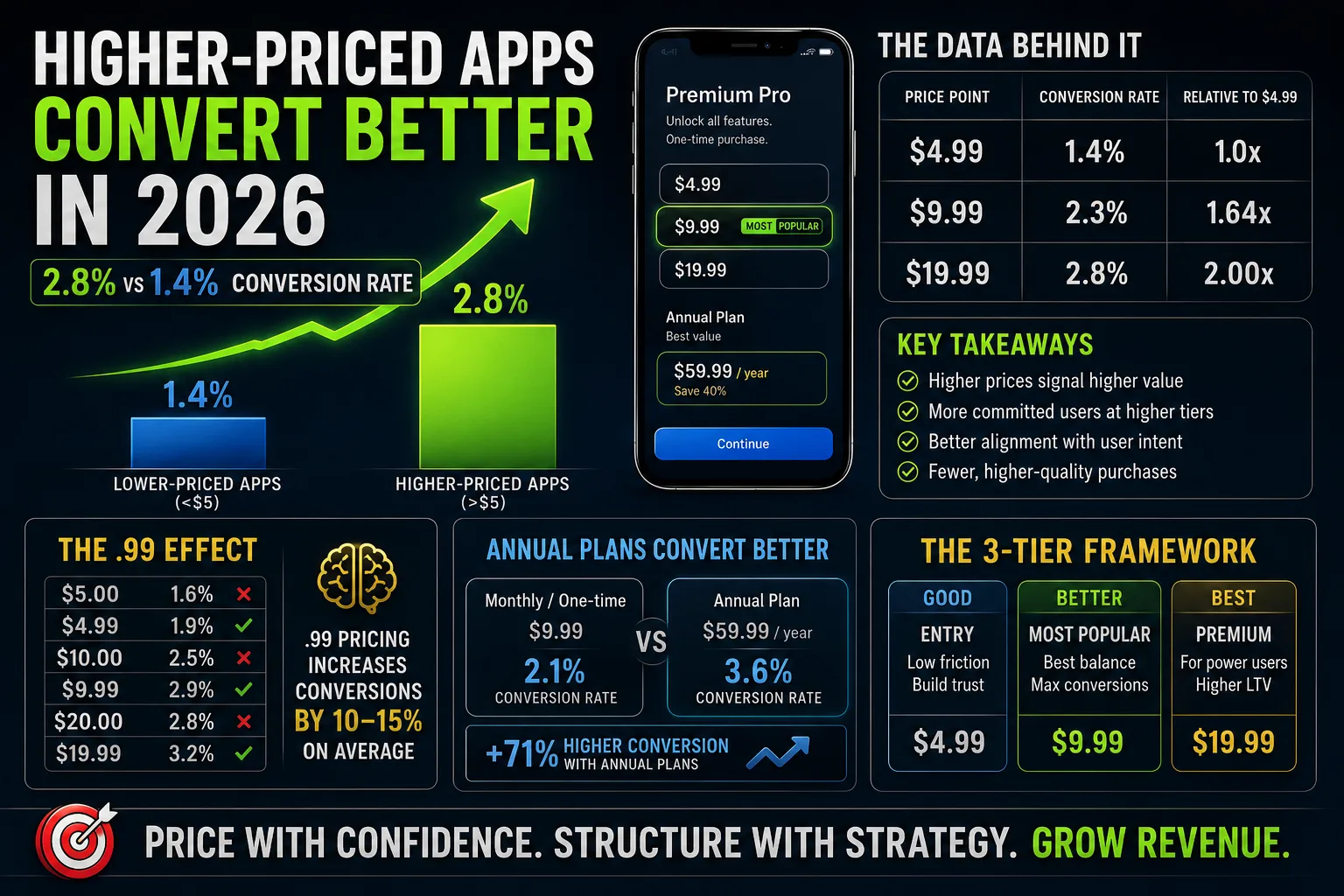
- Low-priced tier (bottom 25% of category): Median 1.4% trial-to-paid conversion. Top quartile reaches 3.7%+.
- Mid-priced tier (25–75%): Median 2.0% conversion. Top quartile reaches 4.4%+.
- High-priced tier (top 25%): Median 2.8% conversion. Top quartile reaches 6.1%+.
This contradicts the intuition that "cheaper converts better." In 2026 data, higher-priced apps convert better on average. The reason: users who tap into a premium-priced app already self-selected — they came looking for a serious solution, not a freebie. Cheap apps attract tire-kickers; expensive apps attract buyers.
The follow-on number is even more striking: high-priced apps generate 1.5–5x more revenue per install than low-priced apps in the same category, despite often having higher absolute conversion. If you're earning $0.30 per install at $4.99, repricing to $9.99 with similar conversion (or even slightly worse) means $0.60–$1.50 per install — pure margin lift on the same traffic.
$4.99 vs $9.99 vs $19.99: the real math
Pick the same 10,000-install month and run three pricing scenarios. The numbers tell the story:
Scenario A — $4.99/month subscription:
- Trial-to-paid conversion: 4% (low-tier rate)
- Paying subscribers: 400
- Monthly subscription revenue: $1,996
- After Apple's 15% commission: $1,697
Scenario B — $9.99/month subscription:
- Trial-to-paid conversion: 2.5% (mid-tier rate)
- Paying subscribers: 250
- Monthly subscription revenue: $2,498
- After Apple's 15% commission: $2,123
Scenario C — $19.99/month subscription:
- Trial-to-paid conversion: 1.5% (high-tier rate)
- Paying subscribers: 150
- Monthly subscription revenue: $2,999
- After Apple's 15% commission: $2,549
The pattern: $19.99 produces 50% more revenue than $4.99 from the same 10,000 installs — even though it has less than half the conversion rate. The math gets more dramatic at scale, because annual subscribers churn at 5–10% per year vs. 30–50% for monthly subscribers, and higher-priced plans skew toward annual.
The implication isn't "always price high." It's "stop assuming low prices mean more revenue." They almost never do.
The 9 ending: why $9.99 beats $10 every time
The single most consistent finding in pricing research: prices ending in .99 (or .95) outperform whole-number prices by 5–10% in conversion. The mechanism is the left-digit effect — your brain processes "$9.99" by reading the "9" first and rounding down, even though the actual price is one cent below ten dollars.
Practical rules:
- $9.99 beats $10.00 by roughly 8% in observed conversion across multiple studies. The cent saved is worth nothing; the perceived discount is worth real money.
- $4.99 beats $5.00 for the same reason, with even larger effect at lower prices where the relative jump from $4 to $5 feels bigger.
- $19.99 beats $20.00 consistently, though the effect is smaller at higher prices.
- $99.99 beats $100.00 but the gap narrows further — at three-digit prices, the left-digit effect competes with round-number anchoring.
- Round numbers ($10, $20, $50) work better for premium positioning. If you're deliberately signaling "we're not a discount product," $20 might outperform $19.99 in conversion among the right segment.
The default for most indie apps: use .99 endings unless you have a specific reason not to.
Three-tier pricing: the structure that wins
Across thousands of subscription apps, the structure that consistently delivers the most revenue is three tiers — not one, not two, not five. The reasoning:
- One tier: Forces a binary "buy or don't" decision. Misses the segment that would have paid for a premium version.
- Two tiers: No anchoring effect, no decoy. Users compare directly, often choosing the cheaper one.
- Three tiers: The middle option becomes the natural default through the "center stage effect." Anchoring against the high tier makes the middle look reasonable. The decoy effect from the low tier pushes users toward the middle.
- Four+ tiers: Creates decision paralysis. Users defer or abandon.
The price jump structure that maximizes the center-stage effect:
- Entry → Mid: 15–30% price jump (e.g., $4.99 → $6.99, or $9.99 → $12.99).
- Mid → Premium: 50–100% price jump (e.g., $9.99 → $19.99, or $14.99 → $29.99).
This structure produces 25–60% increases in average deal size compared to evenly-spaced tiers, because most users gravitate to the middle option — which is where you want them.
Annual plans: where the real money lives
The biggest pricing lever after the monthly price itself is the annual plan. Real 2026 data on annual vs monthly subscribers:
- Monthly subscriber churn: 30–50% per year.
- Annual subscriber churn: 5–10% per year.
- Lifetime value: Annual subscribers are 2–3x more valuable than monthly subscribers, even at the same per-month rate.
- Cash flow impact: Annual subscribers pay upfront, giving you working capital months before you've delivered service.
The optimal annual discount is 15–20%, with 16.7% ("two months free" — paying for 10 months and getting 12) being the most popular structure. Below 15%, the discount isn't enough to overcome reluctance to commit a year in advance. Above 20%, you're giving away margin you didn't need to.
The framing matters as much as the number. "Two months free" outperforms "16.7% off" in most A/B tests, because users mentally value "free time" more than equivalent percentage discounts.
If you only offer monthly subscriptions, you're leaving roughly 40–50% of potential lifetime revenue on the table. The cost of adding an annual tier is minimal; the upside is enormous.
Category-specific pricing benchmarks
Pricing varies dramatically by category in 2026. RevenueCat and Adapty data on median LTV per payer:
- Productivity: $46.97 LTV. Monthly-focused (77% of subscribers choose monthly). Sweet spot: $4.99–$9.99/month.
- Utilities: $46.30 LTV. Mixed monthly/annual. Sweet spot: $2.99–$6.99/month with strong annual upsell.
- Education: $45.10 LTV. Annual-focused. Sweet spot: $9.99–$19.99/month or $59.99–$99.99/year.
- Health & Fitness: Annual-focused (68% choose annual). Sweet spot: $9.99–$14.99/month or $79.99–$129.99/year. Expensive annual plans earn 4.5x more per user than cheap ones.
- Gaming: Weekly-focused (82% choose weekly). Sweet spot: $4.99–$9.99/week. Different mechanics entirely.
- Photo & Video: Mixed. Sweet spot: $4.99–$9.99/month with annual discount.
- Lifestyle: Lower LTV but high volume. Sweet spot: $2.99–$5.99/month.
The key takeaway: match your pricing to your category's behavior, not your gut. A $19.99 fitness app doesn't shock anyone — that's normal. A $19.99 utility might seem absurd. Research your category before pricing.
Localization: don't price globally with US numbers
One of the most common indie pricing mistakes: charging $9.99 worldwide. The same app at the same price means very different things in different markets:
- United States: $9.99/month is 0.04% of median household income. Trivial.
- Germany: €9.99/month is similar — affordable.
- India: $9.99 is roughly 1.5% of median monthly income for many users. Prohibitive.
- Brazil: Similar issue. $9.99 converts to roughly R$50, which is meaningful spending.
App Store and Google Play both support price tiers per region. The 2026 best practice is to use Apple's "Auto-adjusted pricing" (or Google's equivalent) which sets locale-appropriate prices anchored to your home-market price. For markets where this still produces too-high prices (India, Indonesia, Vietnam, parts of Latin America), consider manual lower-tier pricing.
Apps with regional pricing consistently outperform globally-flat-priced apps in international markets — sometimes by 2–3x in conversion in emerging markets.
Free trials: when they help and when they don't
The default advice is "always offer a free trial." The 2026 data is more nuanced:
- Trials help most in: Utilities, Health & Fitness, Education. Apps where users need to experience the value over multiple sessions before deciding to pay.
- Trials help less in: Productivity, Lifestyle, Entertainment, Graphics & Design. Apps where users can evaluate value in one session, so a paywall-direct flow converts comparably or better.
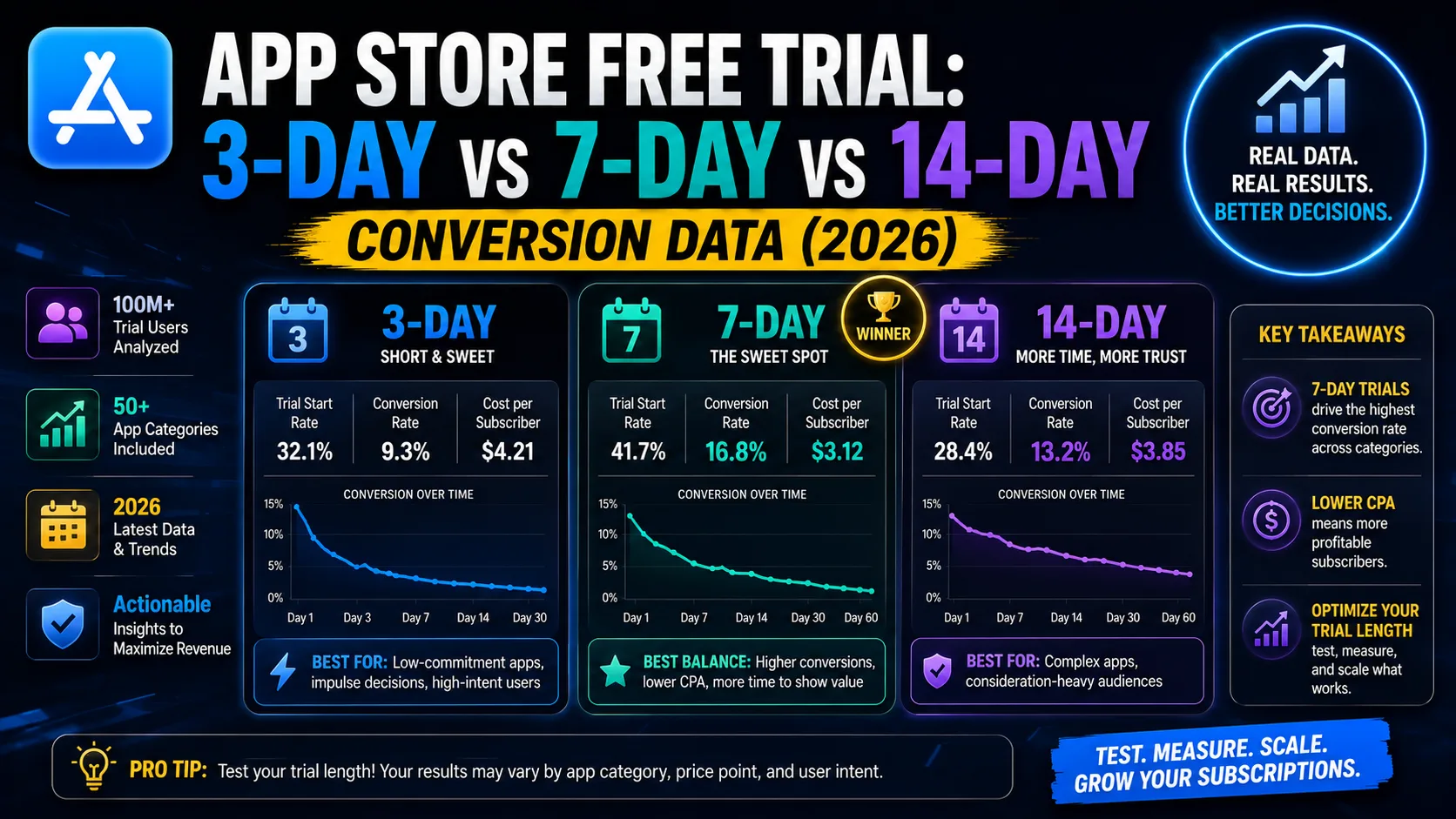
- Trial length matters: 3-day trials convert at lower rates than 7-day trials in most categories, but 7-day trials have higher post-trial conversion. The sweet spot is 7 days for most apps; 14 days for complex tools requiring deeper learning.
- Hard paywalls work for some apps: A premium photo editor or pro tool can sometimes convert better with no trial and a strong screenshot-driven listing than with a trial that lets users get what they need and bounce.
Default for most indie apps: 7-day free trial, annual plan upsell during checkout, and a clear value demonstration in the first 30 seconds of the experience.
The mistakes that cost indie devs subscription revenue
Recurring patterns across underperforming subscription apps:
- Setting price once and never revisiting. A 10% price increase with the same conversion rate drops straight to your bottom line. Most indie apps could safely raise prices 10–25% and lose minimal conversion.
- Copying competitors exactly. If your app delivers more value, you should price higher. If it delivers less, lower. Mirror prices when you're at parity, not by default.
- One-size-fits-all global pricing. Charging $9.99 in India and the US means you're either overcharging India or undercharging the US. Both are revenue mistakes.
- Not offering an annual plan. Annual subscribers are 2–3x more valuable. Leaving the annual option off the table costs 40–50% of potential lifetime revenue.
- Too many tiers. More than 3 tiers for consumer apps creates decision paralysis. Users defer; many never come back.
- No free trial when it would help. Apps with trials convert 2–3x better in categories like utilities and fitness. Trial-less paywalls work for some categories, not all.
- Pricing for the cheapest user. The user who'd pay $4.99 but not $9.99 is often not your best customer anyway. They churn fast, complain frequently, and leave low-star reviews. Pricing higher self-selects for better users.
- Ignoring the left-digit effect. $10 vs $9.99 is one cent in money but 5–10% in conversion. Use .99 endings unless you're deliberately positioning premium.
The pricing framework that actually works
Instead of picking a number, follow a process:
- Step 1: Research your category's price range. Open the App Store, search for 10 competitors, note their monthly and annual prices. You're looking for the 25th percentile, 50th percentile, and 75th percentile — not the average.
- Step 2: Decide your positioning. Cheaper than median (acquisition strategy, high churn risk), at median (safe but unexceptional), or premium (better conversion per install, fewer users, higher LTV). Most indie apps under-position themselves.
- Step 3: Pick three tier prices. Entry (15–30% below mid), Mid (your target price), Premium (50–100% above mid). Use .99 endings.
- Step 4: Add an annual plan at each tier. Discount the annual by 15–20% vs 12× the monthly. Frame as "2 months free" rather than percentage off.
- Step 5: Enable Apple's auto-adjusted regional pricing. Override for markets where the default produces prohibitively high prices.
- Step 6: Decide on free trial. 7 days for most apps, 14 days for complex tools, none for premium positioning. A/B test if you have the volume.
- Step 7: Review quarterly. Track conversion, churn, and revenue per install at each tier. Adjust pricing by $1–2 monthly or $5–10 annually per cycle. Small iterations beat one big repricing.
Frequently asked questions
Should I always end prices with .99?
Almost always, yes. The left-digit effect is one of the most reliably-replicated findings in pricing research, worth 5–10% in conversion. The only exceptions are premium-positioned apps where round numbers signal "we're not a discount product."
What's the sweet spot for indie app pricing?
It depends on category, but for most consumer apps in 2026: $4.99–$9.99/month monthly with a $39.99–$79.99 annual plan (15–20% discount vs 12 months). Premium-positioned apps can go to $14.99–$19.99/month.
How much annual discount should I offer?
15–20% is the optimal range. "Two months free" (16.7% off, paying for 10, getting 12) is the most popular framing and consistently outperforms equivalent percentage off in tests.
Should I offer a free trial?
Default to 7 days for most categories. Skip for some Productivity, Lifestyle, and Entertainment apps where direct paywalls convert comparably. Extend to 14 days for complex tools that need learning time.
Is it OK to raise prices on existing subscribers?
Yes, but grandfather existing subscribers at their original price for 6–12 months to avoid churn spikes. Price changes without grandfathering can cause 10–15% churn spikes. Apple allows price increases with notice.
How often should I review my pricing?
Quarterly. Look at conversion rate, monthly churn, and revenue per install. Test small changes ($1–2 monthly, $5–10 annually) rather than big jumps.
What's the difference between price and packaging?
Price is the dollar amount. Packaging is what each tier includes — features, limits, support level. Most pricing optimization gains come from packaging changes (gating features differently) more than raw price changes.
Should I match competitor prices exactly?
Match when you're at value parity with competitors. Price higher when you deliver more. Price lower if you're using pricing as an acquisition strategy and you understand the LTV trade-off. Don't copy by default.
What's the optimal number of pricing tiers?
Three for consumer apps. Two is too few (no anchoring), four-plus creates decision paralysis. Business and enterprise tools can sometimes support four tiers.
How does Apple's commission affect what I should charge?
Plan around it. If you charge $9.99/month, you net $8.49 under the Small Business Program (15% commission) or $6.99 under the standard 30%. If you're not enrolled in the Small Business Program, you should be — it's 100% of indie developers under $1M in proceeds. Our Small Business Program guide covers the enrollment.
The bottom line
Subscription pricing is the most impactful lever in an indie app business and the one most developers set once and never revisit. The 2026 data is clear: higher-priced apps don't just charge more — they convert better, attract higher-quality users, and generate 1.5–5x more revenue per install. Three tiers with .99 endings, an annual plan at 15–20% discount, regional pricing, and a 7-day trial cover the structural decisions for 80% of indie apps. The remaining 20% comes from quarterly iteration on the specific numbers — small adjustments, measured carefully, applied over time. The developers who win at subscription pricing aren't the ones who guessed right at launch; they're the ones who treated pricing as a permanent ongoing project.
Once your pricing structure is solid, the infrastructure layer matters too. Our RevenueCat vs in_app_purchase guide covers the build-vs-buy decision for subscription backend, and the Google Play 15% fee guide covers the commission math on Android — including the new 10% subscription rate coming in 2026.
Related posts
Make your App Store screenshots free
LaunchShots is a free, in-browser screenshot maker. No signup, no watermark.
Open the app →
Comments (0)