Flutter vs React Native 2026: Honest Comparison for Indies
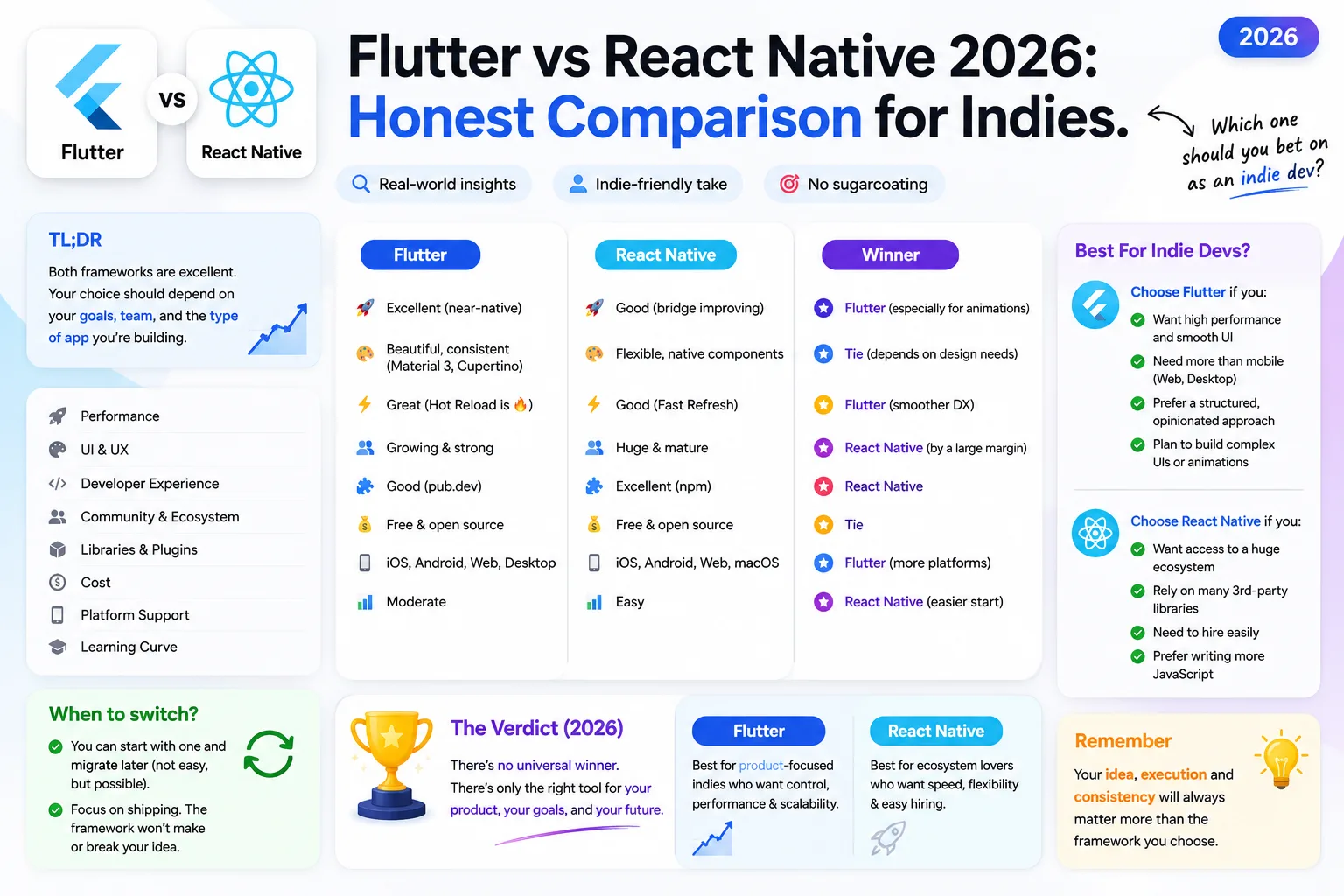
Choosing between Flutter and React Native is one of the highest-stakes decisions an indie mobile developer makes. The wrong choice doesn't just slow you down — it locks you into a hiring pool, an ecosystem, and a learning curve for the next three years. In 2026 both frameworks are mature, production-grade, and capable of shipping any consumer app you can imagine. The differences aren't about which is "better" — they're about which fits your situation. Flutter holds 46% of the new cross-platform market, React Native holds 35–38%, and the gap is closing. This is the honest 2026 comparison for indie developers: real benchmarks, real ecosystem data, real cost math, and the specific scenarios where each one is the right choice.
The 2026 state of the two frameworks
The 2018-era arguments about which framework "wins" are over. Both ship production apps with hundreds of millions of users. The relevant question for an indie developer in 2026 is which one fits your specific situation:
- Flutter (Google, 2017): Dart language, custom rendering engine (Impeller), 6+ official platforms (iOS, Android, Web, macOS, Windows, Linux). 170K GitHub stars, ~46% cross-platform market share for new projects in 2026.
- React Native (Meta, 2015): JavaScript/TypeScript, native UI components, New Architecture (Fabric, TurboModules, JSI). 119K GitHub stars, ~35–38% market share, but 67% of developers already know JavaScript — the largest active talent pool.
The performance gap that defined the early debate has effectively closed. React Native's New Architecture delivers near-native performance for standard UIs; Flutter's Impeller engine delivers consistent 120 FPS animations and superior memory efficiency for visually complex apps. For 90% of consumer apps, end users cannot tell which framework built them.
The hard numbers in 2026
Where the two frameworks measurably differ — based on independent benchmarks from early 2026:
- Memory usage: Flutter ~120 MB / React Native ~145 MB (Flutter bundles its rendering engine; React Native uses system UI components).
- App binary size: Flutter 15–20 MB / React Native 8–15 MB (React Native ships smaller; matters in emerging markets on slow connections).
- Hot reload speed: Flutter 0.4–0.8s / React Native 1–2s (Flutter's Dart compiler is faster).
- Cold start time: Flutter 1.4–1.8s / React Native 1.9–2.3s on mid-range Android (Flutter's Ahead-of-Time compilation).
- Animation performance: Flutter consistent 120 FPS / React Native 60 FPS standard, 120 FPS on Fabric (Flutter wins on heavy animation).
- Package ecosystem: React Native ~1.8M npm packages / Flutter ~50K pub.dev packages (React Native is dramatically larger, but pub.dev is more curated).
- Job market (North America, 2026): React Native ~6,800 open positions / Flutter ~3,200 (React Native is bigger, Flutter is growing faster).
- Average salary: React Native developers earn 5–10% more on average, reflecting larger enterprise adoption.
- GitHub stars: Flutter 170K / React Native 119K.
- Production apps generating $10K–$100K MRR: Roughly equal — 790 React Native vs 727 Flutter (Statista 2026).
The pattern: Flutter wins on raw performance and developer experience during coding. React Native wins on ecosystem breadth, hiring availability, and smaller app sizes.
Languages: Dart vs JavaScript/TypeScript
The language choice often matters more than the framework choice, especially for indie developers who are also their own engineers:
Dart (Flutter):
- Statically typed, object-oriented, Google's own language.
- Strong null safety, clean syntax, no runtime surprises.
- Smaller community — roughly 1.8% of developers globally know Dart.
- Learning curve: 2–4 weeks for an experienced developer to feel productive.
- Cannot reuse code with web (different language entirely).
JavaScript/TypeScript (React Native):
- Dynamically typed by default, statically typed via TypeScript.
- 67% of developers globally already know it — by far the largest talent pool.
- Massive ecosystem inherited from npm (1.8M packages).
- Learning curve: 2–3 weeks for an experienced React web developer.
- Strong code reuse potential with React web (60–70% in well-architected codebases).
For solo indie developers coming from web development, React Native's learning curve is dramatically shorter. For developers starting fresh on mobile with no prior framework loyalty, Dart and Flutter consistently rate higher in developer satisfaction surveys.
UI approach: identical-everywhere vs native-everywhere
This is the most consequential architectural difference, and it shapes how each framework feels to use:
Flutter's approach: pixel-perfect identical UI. Flutter renders every UI element itself via its Skia/Impeller engine. A button in your Flutter app looks identical on every platform — same pixels, same animations, same behavior. Pros: total design control, perfect cross-platform consistency, branded UI that matches your design system exactly. Cons: your iOS app doesn't automatically look "iOS-y" — you opt into platform-native styling (Cupertino widgets on iOS, Material on Android) or live with a unified look that doesn't match either platform.
React Native's approach: native components. React Native renders to native UIKit components on iOS and native Android Views on Android. A button in React Native uses the platform's actual button. Pros: feels native on every platform, automatic accessibility and dark mode handling, smaller binary size. Cons: cross-platform UI differences are inevitable — your iOS and Android apps will look slightly different by default, and matching them pixel-for-pixel requires per-platform code.
Both approaches are valid. The right choice depends on whether your design system prioritizes platform conventions (React Native) or brand consistency (Flutter).
Cost: real numbers for indie developers
Both frameworks are free to use. The real costs are time and hiring:
- Solo MVP timeline: Flutter 12–16 weeks / React Native 10–14 weeks for an experienced JS developer, equivalent for someone learning the framework.
- Cost of contractor help: React Native developers cost slightly more per hour but more are available; Flutter developers are scarcer but slightly cheaper on average.
- Ongoing maintenance: Both ecosystems require updates 2–3 times per year. Flutter updates are usually smoother (single source of truth); React Native updates have historically been more disruptive but have stabilized significantly since the New Architecture.
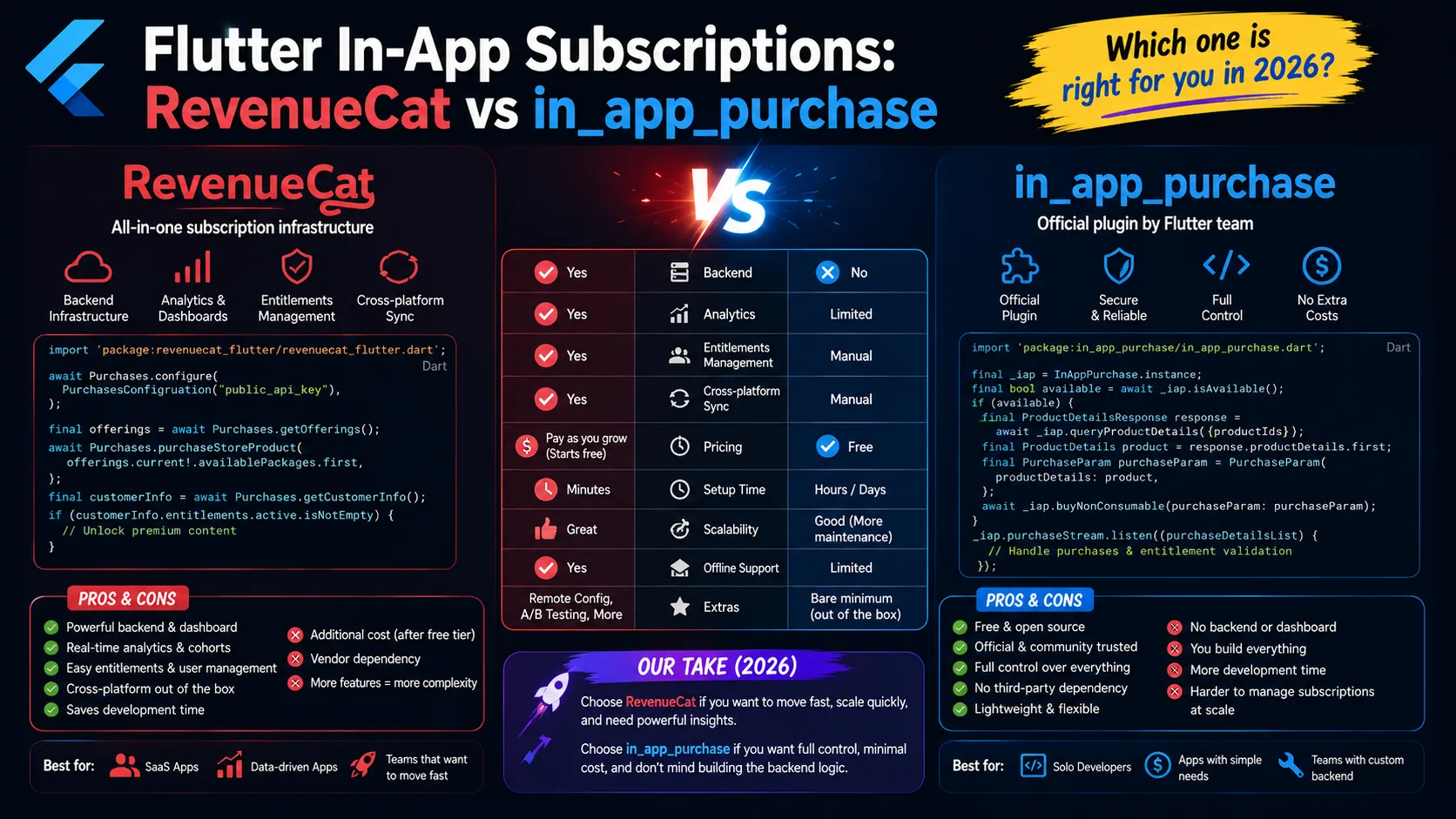
- Subscription infrastructure cost: Both frameworks integrate cleanly with RevenueCat (purchases_flutter and react-native-purchases), and the cost structure is identical regardless of framework. Our Flutter subscriptions guide covers the build-vs-buy math for that layer.
When Flutter is the right call
Flutter is the better choice for specific situations that match its strengths:
- You want pixel-perfect UI control across platforms. If your app's identity is the UI itself — custom illustrations, branded animations, design-system-heavy interfaces — Flutter's rendering control is unmatched. Apps like Reflectly, Hamilton (Musical), Nubank, and Alibaba use Flutter for exactly this reason.
- You ship to more than iOS and Android. Flutter's native support for macOS, Windows, Linux, and web from the same codebase is significantly more mature than React Native's web/desktop story. If you'll eventually want a desktop or web version, Flutter saves work later.
- Your app is animation-heavy. Games, photo editors, video apps, AR-adjacent experiences — anywhere 120 FPS animations and smooth complex transitions matter, Flutter's Impeller engine has a measurable edge.
- You're starting fresh with no prior framework loyalty. Developers learning their first mobile framework often report higher satisfaction with Dart and Flutter than with JavaScript and React Native. The framework feels more cohesive and the documentation is more curated.
- You prioritize developer experience and tooling. Hot reload speed, the Dart compiler's error messages, and Flutter's widget inspector are all genuinely best-in-class.
When React Native is the right call
React Native is the better choice for an equally clear set of situations:
- You already know React or JavaScript well. The shortest path to a shipping app is the framework whose language you already speak. Time saved on learning curve is time spent on product.
- You're sharing code with a React web app. 60–70% of business logic and UI structure can be shared between a React web app and a React Native app with proper architecture. Flutter has no comparable code reuse with web. For teams shipping both, this is decisive.
- You need maximum ecosystem breadth. 1.8M npm packages dwarfs Flutter's 50K. If you need a niche SDK — a specific analytics tool, a regional payment provider, an obscure hardware integration — React Native almost certainly has a maintained library; Flutter may not.
- You'll hire freelancers or build a team. 6,800 open job postings vs 3,200 means the talent pool is meaningfully larger. Recruiting Flutter developers in non-tech-hub cities can be slow.
- Native iOS/Android look-and-feel matters more than brand consistency. If your app should look unmistakably like an iOS app on iPhone and an Android app on Android, React Native's native UI components do this automatically.
- App size is a critical constraint. If your audience is in emerging markets on slow connections and low-end devices, React Native's 8–15 MB binary is meaningfully smaller than Flutter's 15–20 MB.
Real-world apps shipped on each
Both frameworks have shipped category-defining apps. A non-exhaustive look at production apps in 2026:
Flutter: Google Pay, Nubank (50M+ users), Alibaba, BMW, eBay Motors, Reflectly, Toyota in-vehicle systems, Hamilton (Musical), iRobot. Particularly strong in finance, automotive, and design-forward consumer apps.
React Native: Facebook, Instagram, Discord, Shopify, Coinbase, Wix, Microsoft Office mobile apps, Tesla, Walmart, Pinterest. Particularly strong in social, e-commerce, and apps with shared web/mobile codebases.
The list-by-list comparison tells you something useful: neither framework is "for serious apps" or "for hobby projects" — both are running multi-billion-dollar businesses in 2026. The question isn't which is real; it's which fits your context.
The third option: Kotlin Multiplatform
Worth acknowledging because it grew from 7% to 23% cross-platform share in 18 months: Kotlin Multiplatform (KMP) takes a different approach entirely. It shares business logic in Kotlin while letting you use fully native UI (SwiftUI on iOS, Jetpack Compose on Android). The result: native UI on every platform, shared logic where it matters, and zero compromise on platform feel.
KMP makes sense if:
- You already have a native Android team using Kotlin.
- Your design strategy requires platform-native UI on both sides.
- You're comfortable maintaining two UI codebases for the gains in feel.
KMP doesn't make sense if you're a solo indie developer trying to ship fast — maintaining native iOS and native Android UI in parallel is significantly more work than either Flutter or React Native. For most indie developers, KMP is the wrong answer for the wrong reasons; for some enterprise contexts, it's becoming the right one.
The decision framework that actually works
Rather than "which is better," ask yourself five questions in order:
- 1. Do I know React/JavaScript well? If yes, React Native is the shortest path. The time you save on learning curve dwarfs marginal performance differences. If no, the language question is open.
- 2. Will I ship a web version using the same team? If yes, React Native shares 60–70% of code with React web. Flutter doesn't share with web meaningfully. Big win for React Native.
- 3. Is UI brand consistency more important than platform-native feel? If brand consistency matters more (design-heavy apps, distinct visual identity), Flutter. If platform feel matters more (utilities, productivity, social), React Native.
- 4. Will I eventually need desktop versions? If yes, Flutter's desktop story is meaningfully more mature. If no, this isn't a tiebreaker.
- 5. Am I building animation-heavy or visually complex experiences? If yes, Flutter's performance advantage compounds. If no, both perform fine.
If you answered "React Native" to most: pick React Native. If you answered "Flutter" to most: pick Flutter. If it's mixed, defer to the language you already know — for a solo indie developer, the language you already speak is usually the deciding factor.
Common mistakes when choosing
Patterns that consistently lead indie developers to the wrong framework:
- Choosing based on a single benchmark. "Flutter is 25 MB faster cold-start" doesn't matter if you ship a productivity app where users open it twice a day. Match the benchmark to your actual app.
- Following Twitter/Reddit drama instead of your situation. Both communities have evangelists; both write articles claiming their framework "won." Real production apps ship on both. Ignore the noise.
- Optimizing for a hypothetical future hire. "I should pick the framework where I can hire later" is reasonable, but you can hire for both in 2026. Don't pick the wrong framework now to optimize for a hire that may not happen.
- Switching mid-project. The cost of switching frameworks after 3+ months of work is enormous and rarely worth it. Pick well, then commit.
- Ignoring the language preference. Developers ship faster in languages they enjoy. If you find Dart annoying, you'll be slower in Flutter regardless of its technical merits. Same for JavaScript and React Native. Personal preference is a legitimate factor.
Frequently asked questions
Which framework has better performance?
For animation-heavy and visually complex apps, Flutter has a measurable advantage (consistent 120 FPS via Impeller, lower memory footprint). For standard business apps, React Native's New Architecture delivers near-native performance that's indistinguishable from Flutter to end users. The performance gap is smaller in 2026 than at any point in the framework debate's history.
Which is easier to learn?
If you already know JavaScript or React, React Native is dramatically faster to pick up — typically 2–3 weeks to productivity. If you're learning your first mobile framework, Flutter and Dart are considered more cohesive by most learners, but the learning curve is 2–4 weeks for an experienced developer.
Which has more jobs?
React Native has roughly 2× more open positions in North America (6,800 vs 3,200 in 2026 data), but Flutter is growing faster. Both offer strong career prospects.
Can I share code with my web app?
Yes, with React Native — 60–70% of business logic and UI structure can be shared with a React web app. Flutter has Flutter Web, but you can't share code with a React web codebase. If a shared web/mobile codebase matters, React Native is the right choice.
Which uses more memory?
Flutter typically uses 120 MB of memory; React Native uses ~145 MB. Flutter wins on memory efficiency, though both are acceptable for modern devices.
Which has smaller app sizes?
React Native typically produces smaller binaries (8–15 MB) than Flutter (15–20 MB), because Flutter bundles its entire rendering engine. For audiences in emerging markets on slow connections, this can matter.
Are big companies still using React Native?
Yes — Meta, Microsoft, Shopify, Discord, Coinbase, Tesla, Walmart, and Pinterest all ship React Native in production in 2026. The "is React Native dying?" question is settled — it isn't.
Is Flutter going to win long-term?
Flutter has higher market share growth for new projects (46% vs 35–38%), but React Native is far from declining. Both frameworks have strong corporate backing, active communities, and clear roadmaps. Long-term, both are likely to remain dominant — and Kotlin Multiplatform is emerging as a third option for some use cases.
Can I use both in the same company?
Yes, but unless you have a strong reason (legacy codebase, team specialization), single-framework focus produces better outcomes. Maintaining two cross-platform stacks doubles the maintenance overhead.
What about Kotlin Multiplatform?
KMP is a strong third option for teams with native Android Kotlin expertise who want native UI on both platforms. For solo indie developers, the maintenance cost of two native UI codebases usually outweighs the gains. KMP grew from 7% to 23% cross-platform share in 18 months, but it serves a different use case from Flutter or React Native.
The bottom line
For solo indie developers in 2026, the right framework is the one whose language you know and whose strengths match your app. If you know JavaScript: React Native, almost always. If you're learning fresh and care about UI consistency or animation-heavy interfaces: Flutter. If you're shipping a multi-platform desktop+mobile experience: Flutter. If you'll have a React web app sharing code: React Native. Both ship production apps with hundreds of millions of users; the wrong choice for you is the one that doesn't match how you actually build.
Whichever framework you pick, the launch infrastructure beyond the code is identical. You'll still need to handle subscriptions (covered in our Flutter subscriptions guide), ship App Store screenshots that convert, write ASO copy that ranks, and handle the financial side of Apple's commission structure. Our guides on the Apple Small Business Program and Google Play 15% service fee cover the financial side for both stores in 2026.
Related posts
Make your App Store screenshots free
LaunchShots is a free, in-browser screenshot maker. No signup, no watermark.
Open the app →
Comments (0)