Meta Ads for App Install 2026: Facebook & Instagram Guide
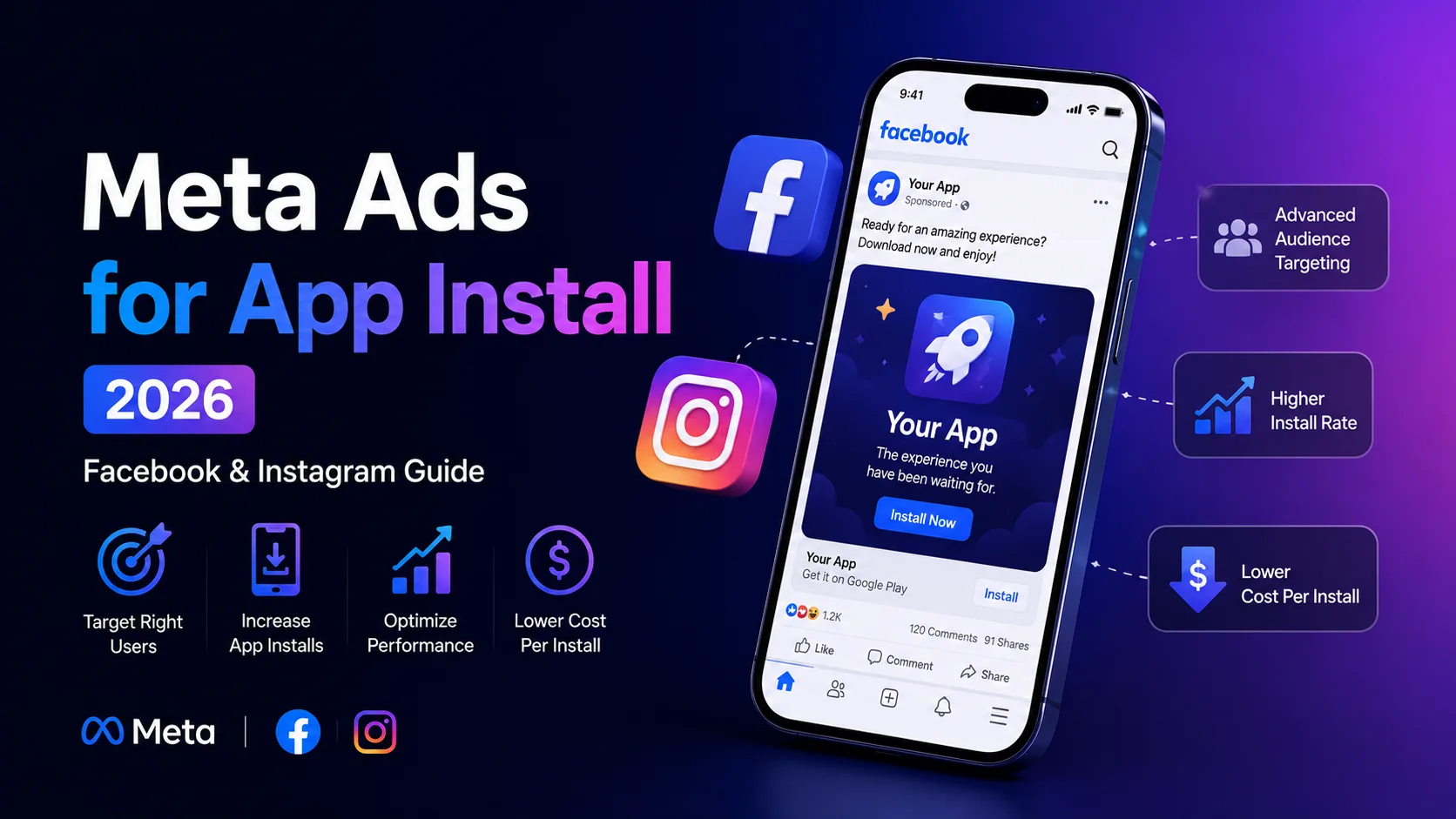
Apple Search Ads catches users actively searching for your category. Google App Campaigns scales reach across Google's entire ecosystem. Meta Ads — Facebook plus Instagram — does something neither does: it interrupts users in their feed with high-quality visual creative and converts based on attention and demographics rather than search intent. In 2026, Meta averages $0.50–$3.00 CPI for consumer apps and $3–$15 for productivity or business apps, sits at 2.19x median ROAS (vs Google's 3.31x and TikTok's 1.41x), and has rebuilt iOS attribution through SKAdNetwork postbacks and Conversions API (CAPI) after ATT broke last-click measurement. Most indie developers treat Meta as "the visual one" and underestimate how much it competes head-on with ASA and GAC on quality-adjusted ROAS. The truth: Meta is a different acquisition shape — broader-funnel, creative-dependent, demographically-targeted — and it pairs well with ASA and GAC rather than competing for the same dollar. This is the operator-level guide for indie developers in 2026: where Meta structurally wins, where it doesn't, the Advantage+ campaign that produces 20–30% better CPI than manual setups, and the framework for adding Meta to your portfolio after ASA and GAC are stable.
What Meta Ads for app install actually is
Meta Ads for app install runs across Facebook, Instagram, and (since 2024) Threads, with placement across Feed, Stories, Reels, Marketplace, and Audience Network. The 2026 product family for app marketers:
- App Promotion campaigns: The standard structure. You upload creative (image, video, or carousel), define a budget, and Meta delivers the campaign across placements. Optimized for installs, app events, or value (revenue).
- Advantage+ App Campaigns: Meta's AI-driven automated app campaign type, launched in mid-2023, fully matured by 2026. Meta automates creative testing, audience targeting, and placement optimization. Median 20–30% lower CPI than manually-managed campaigns for the same app.
- Conversion API (CAPI): Server-to-server event sending that bypasses browser/SDK attribution gaps caused by ATT, ad blockers, and signal loss. Required for serious iOS performance — apps without CAPI in 2026 see 10–20% higher CPI due to incomplete signal.
- SKAdNetwork integration: Apple's privacy-friendly attribution framework. Meta supports SKAN 4.0 with multiple conversion postbacks across windows. iOS attribution is now cohort-style, not per-install — a critical shift from pre-2021 last-click.
- Placements: Feed (lowest CTR but highest reach), Reels (highest engagement, 26% lower CPC than Feed), Stories (mid-range), Audience Network (off-Meta inventory, lowest cost, lowest quality).
The shorthand: Meta Ads is the creative-driven, interruption-based, broad-audience acquisition channel. It works when your visual creative is strong, your audience is broad, and your monetization can sustain a $0.50–$5 CPI depending on category.
The 2026 CPI benchmarks: where Meta sits
Real benchmarks from AppsFlyer, RocketShip HQ, Stackmatix, Triple Whale, and Superads 2026 data:
Meta CPI by category (consumer apps):
- Hypercasual games: $0.10–$0.50 (lowest of any category due to broad targeting and zero-commitment installs).
- Casual games: $0.50–$1.50.
- Mid-core games: $1.50–$4.
- Photo & Video: $1.50–$3.50.
- Education: $1.50–$3.50.
- Lifestyle: $2–$4.
- Health & Fitness: $2.50–$5.
- Productivity / Tools: $3–$8.
- Fintech / Banking: $5–$15+ (highest, driven by incumbent bidding for high-LTV users).
- Subscription apps overall: $2–$5 average.
iOS vs Android:
- iOS CPI: Typically $2–$5+ across categories. iOS premium reflects ATT-driven attribution gaps that Meta partially closes via CAPI but doesn't eliminate.
- Android CPI: Typically $1–$3 across categories. Cleaner attribution flow keeps costs lower.
- Tier 1 markets (US/UK/CA/AU): Baseline CPI range above.
- Tier 2 (Western Europe, Japan, Korea): 20–40% lower.
- Tier 3 (SEA, LATAM, India): 60–85% lower.
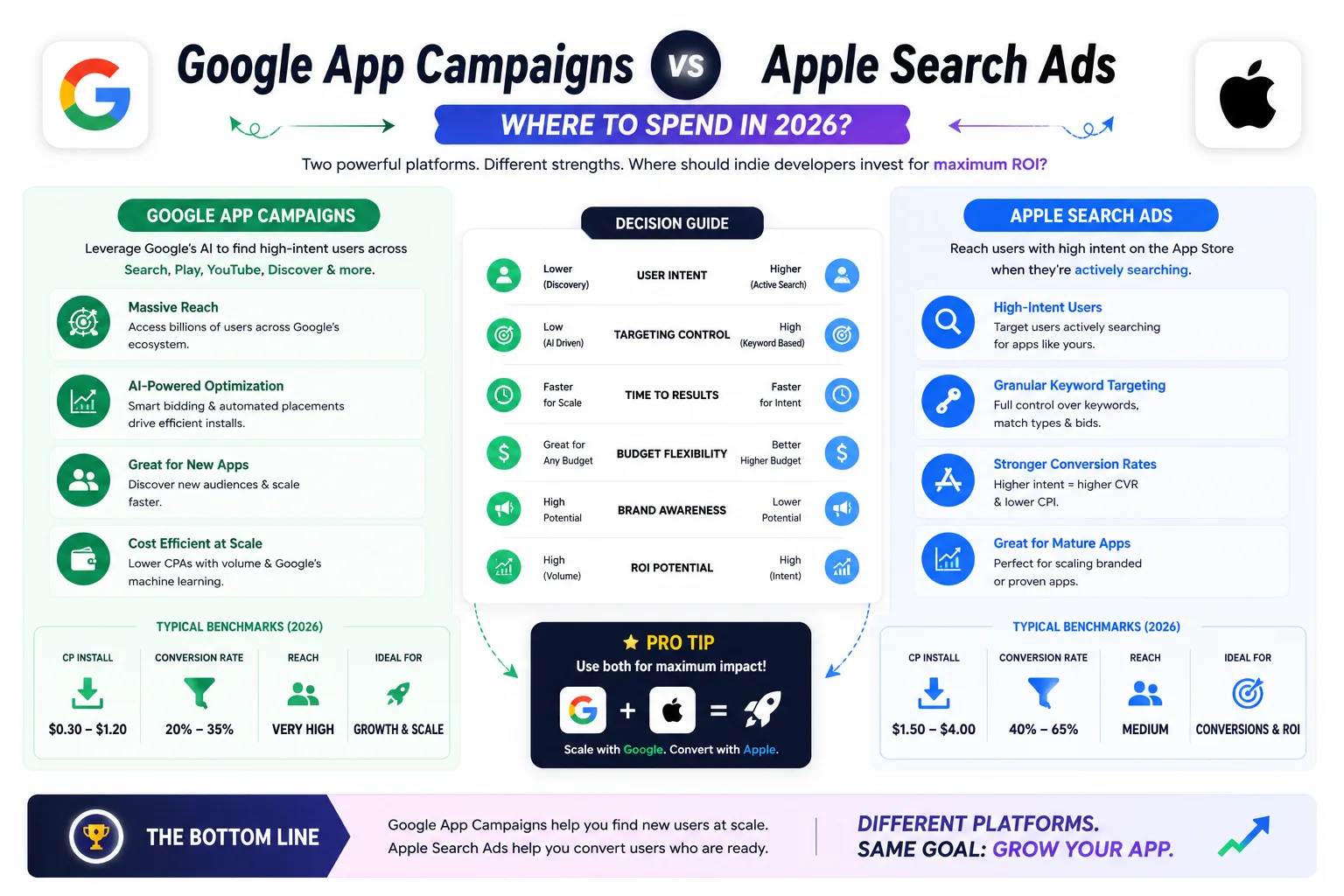
The pattern: Meta CPI sits between GAC ($1.29 avg) and ASA ($1.80 avg) for most consumer apps. The trade-off is signal quality — Meta installs are creative-attention-driven, not search-intent-driven. ROAS calibration matters more here than on ASA.
Meta vs ASA vs GAC: the role each plays
The three channels solve different acquisition problems. Most mature 2026 portfolios run all three, not because they're interchangeable but because each fills a structural gap:
- Apple Search Ads (ASA): Bottom-funnel, highest-intent, iOS-only. Users actively searching the App Store for your category. CR averages 67.2% (industry-leading). Captures users who already know what they want.
- Google App Campaigns (GAC): Mixed-funnel, broad reach, cross-platform. Runs across Search, YouTube, Display, Discover, Play Store. ML-driven targeting; lower CPI than ASA but lower intent on average.
- Meta Ads (Facebook + Instagram): Top-to-mid-funnel, demographic + interest targeting, cross-platform. Visual creative interrupts users in their feed. Best when your audience is well-defined demographically and your creative can win attention.
The mature 2026 allocation for cross-platform indie apps: roughly 50% ASA, 30% GAC, 20% Meta as a starting baseline. The Meta share grows for apps with strong visual creative (lifestyle, fashion, fitness, games) and shrinks for apps where the value prop is hard to communicate visually (developer tools, productivity utilities, B2B SaaS).
For the ASA deep dive, our Apple Search Ads ROI guide covers ASA campaign structure and bid framework. For ASA vs GAC budget allocation, our GAC vs ASA comparison covers the 60/40 framework. This guide picks up the third leg.
Where Meta Ads structurally wins
Despite Meta's mid-tier CPI, there are specific situations where Meta outperforms ASA or GAC:
- Your app is visually compelling. Photo apps, fashion apps, fitness, food, travel, design — anything where users can understand the value in 3 seconds of vertical video wins on Meta's feed-based placement model.
- Your audience is demographic, not search-intent. "Women 25–40 interested in mindfulness" is hard to target on ASA (no search query maps cleanly to that demographic) and noisy on GAC. Meta's demographic + interest targeting hits this group naturally.
- You can produce volume of creative. Meta's algorithm wins when fed 80–120 creative variants per month. Top-quartile teams running this volume see meaningfully lower CPI than median performers. Creative velocity is the single biggest CPI lever on Meta.
- You have strong organic content to remix into ads. Apps with UGC, influencer content, or strong brand video assets convert this content directly into top-performing ads at fraction of original production cost.
- Your re-engagement opportunity is large. Meta re-engagement campaigns targeting lapsed users typically cost 60–70% less per re-activation than acquiring new users through cold prospecting.
- You operate in non-English markets where Meta dominates social. India, Brazil, Indonesia, Philippines, Mexico — Meta penetration is enormous and CPCs run 70–85% lower than Tier 1.
- You can invest in CAPI infrastructure. Apps with server-side event tracking via Conversions API see 10–20% CPA reduction from improved signal quality. The infrastructure investment pays back quickly.
Where Meta Ads structurally loses
Equally honest about when to skip Meta or under-allocate:
- Your value prop requires text explanation. Developer tools, productivity utilities, complex B2B apps — these don't convert well on a 3-second feed scroll. ASA's intent-driven search audience handles them better.
- You can't produce creative at volume. Without 10+ creatives per month, Meta's algorithm starves. CPI inflates. ASA's search-driven model needs no creative production.
- Your audience is narrowly intent-driven. Users explicitly searching "habit tracker app" or "quit smoking" want a specific solution. ASA captures this intent at high CR. Meta has to interrupt and convert in feed — harder for these audiences.
- Your iOS app monetizes purely on IDFA-dependent attribution. Post-ATT, Meta's iOS attribution is partial. If your business model requires last-click iOS attribution, Meta is hardest hit among the three platforms.
- Your category is over-saturated on Meta. Fintech, weight loss, gambling — these have aggressive incumbent advertisers driving CPI to $10–$30. Indie apps can't sustain those auctions without exceptional LTV.
- You don't have CAPI implemented. Without server-side event tracking, Meta iOS optimization is severely handicapped. The cost of running Meta without CAPI in 2026 often exceeds the value.
- Your app is under 4.0 stars. Meta requires a strong listing conversion rate to make ads work. Sub-4.0 apps see 25–40% higher CPI because click-through doesn't translate to install. Fix ratings first — see our rating optimization guide.
The Advantage+ App Campaign: Meta's automated path
The single biggest Meta product change for app marketers in 2026 is the maturation of Advantage+ App Campaigns. These AI-driven automated campaigns now consistently outperform manually-configured campaigns by 20–30% on CPI for the same app.
How Advantage+ App Campaigns work:
- You provide creative assets. Multiple images, videos, and carousels — ideally 5–15 creative variants per campaign.
- You set a budget and target outcome. Either app installs, app events (e.g., trial start, purchase), or value (revenue).
- Meta automates targeting. No manual audience definition. Meta's algorithm uses pixel data, CAPI events, and demographic signals to identify app installer profiles automatically.
- Meta automates creative testing. The system tests combinations of headlines, body copy, images, and videos. Winners get more spend; losers get less.
- Meta automates placements. Distribution across Feed, Stories, Reels, and Audience Network is optimized algorithmically.
- You optimize at the campaign level, not the ad set level. Less granular control, but the algorithm handles the optimization that manual managers used to do manually.
The trade-off: Advantage+ gives up granular control in exchange for algorithmic performance. For indie developers without deep paid marketing expertise, this is almost always the right trade — manual campaigns require ongoing optimization that beats Advantage+ only at significant scale (typically $20K+ monthly spend) and with dedicated paid marketing operators.
Default starting point for indies: Advantage+ App Campaign with $30–$50/day budget, 5–10 creative variants, CAPI implemented. Optimize for app event (trial start or purchase) once you have 50+ tracked events per week.
The creative strategy that wins on Meta in 2026
Meta is a creative-driven platform. The single largest performance lever is creative quality and velocity. The patterns that consistently win in 2026:
- 15-second vertical video. The 2026 format that beats every other on mobile. Vertical fits feed natively; 15 seconds matches attention windows; video carries information density that static can't.
- Native-feeling creative. Ads that look like organic user content (UGC-style) achieve 20–30% lower CPI than polished commercial creative. Counter-intuitive but consistent in 2026 data.
- Hook in the first 1.5 seconds. Users scroll fast. The first frame must stop the scroll. Question, surprising claim, recognizable face, transformation moment — whatever stops the scroll.
- Show the product, not just talk about it. Screen recordings of the app working beat abstract benefit headlines. Demonstrate the value, don't describe it.
- Reels-first thinking. Reels placement now drives ~26% lower CPC than Feed. Design every ad for Reels first; reformat for Feed and Stories afterward.
- UGC and creator content. Authentic phone-recorded testimonials outperform polished studio production by 40%+ in CTR for many categories.
- Volume of creative variants. 80–120 creative variants per month is the top-quartile pace. Below 10/month, Meta's algorithm starves. The compound CPI advantage from creative velocity is real and large.
iOS attribution after ATT: the CAPI requirement
Apple's App Tracking Transparency (ATT) framework, introduced in iOS 14.5 and now fully enforced in 2026, broke last-click attribution for Meta iOS campaigns. The replacement system:
- SKAdNetwork (SKAN 4.0): Apple's privacy-friendly attribution framework. Provides cohort-style postback data (not per-user). Multiple postbacks across conversion windows give Meta partial signal.
- Conversions API (CAPI): Server-side event sending from your backend directly to Meta. Bypasses browser/SDK attribution gaps. The single highest-impact technical implementation for Meta iOS performance in 2026.
- Aggregated Event Measurement (AEM): Meta's privacy-preserving measurement that respects ATT opt-outs while still providing aggregate attribution.
What this means in practice:
- Apps without CAPI see 10–20% higher CPA compared to identical apps with CAPI implementation.
- iOS attribution lag is real. Postbacks arrive days after installs, not in real-time. Optimization happens on delayed cohort data, not last-click.
- Day 1 ROAS on iOS is misleading. Plan for D7 or D30 ROAS evaluation on Meta iOS campaigns. Last-click day-1 calculations no longer reliably reflect actual performance.
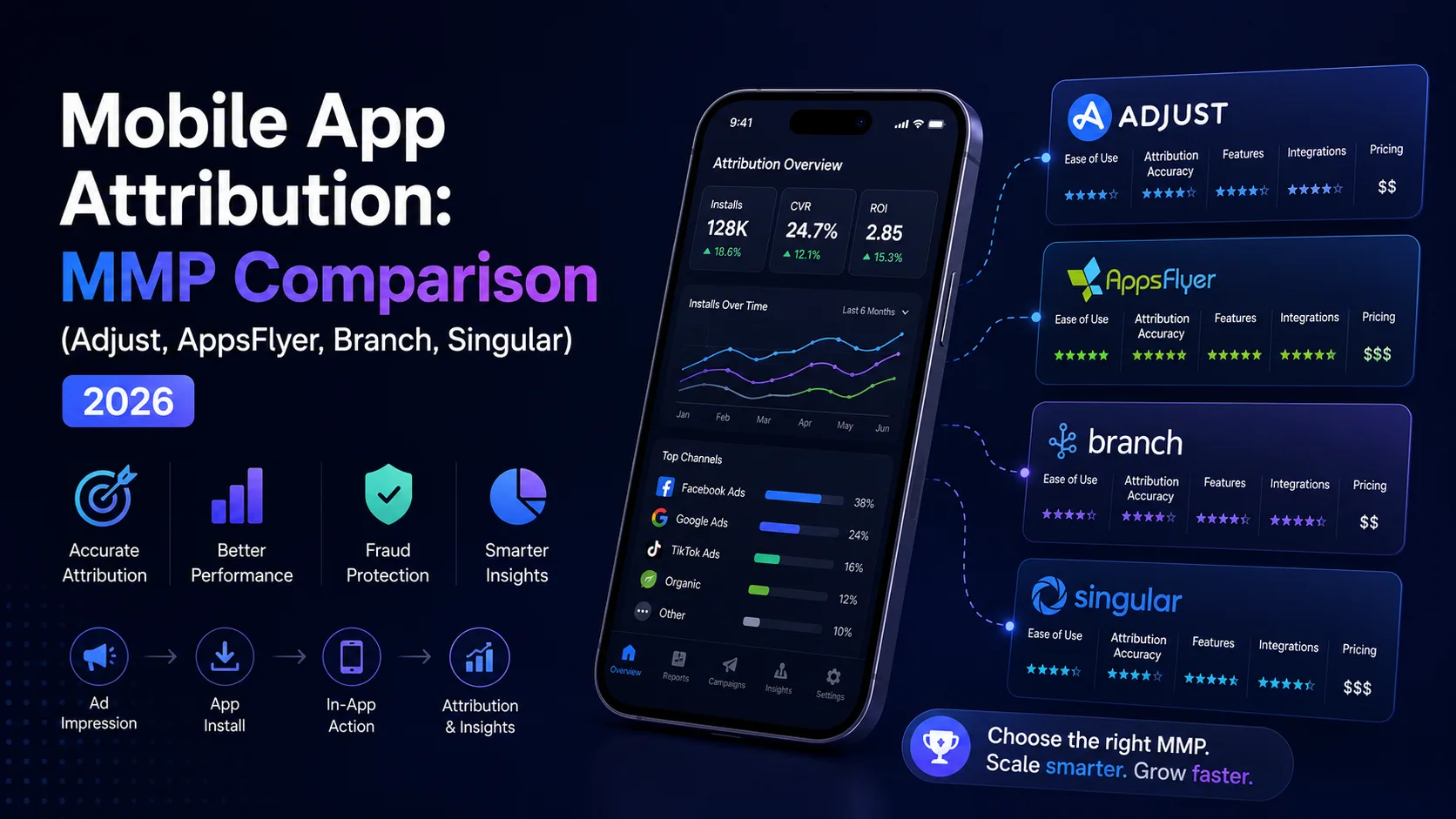
- Server-side event tracking is non-negotiable in 2026. Either implement CAPI directly or use a third-party platform (Adjust, AppsFlyer, Branch) that handles it.
For most indie developers, the recommended path: use a Mobile Measurement Partner (MMP) that handles SKAdNetwork postback aggregation and CAPI server-side event forwarding. The MMP cost ($300–$1,500/month depending on volume) is dwarfed by the attribution accuracy improvement.
The bid strategies that work for indie apps
Meta exposes three main bid strategies for app campaigns:
- Lowest cost (default): Meta tries to get the most installs for your budget. No cap, no minimum. Use during initial learning phase. Best for first 30 days.
- Cost cap: Sets a maximum average CPA for the campaign. Meta tries to keep average cost at or below the cap. Use once you have stable cost-per-install data. Set cap at 1.5–2x your target CPA for adequate delivery.
- Bid cap: Sets a maximum bid in any single auction. Tighter control but reduces volume significantly. Use only when you have strict cost requirements.
- Minimum ROAS: Sets a floor for ad spend return. Meta only serves impressions predicted to generate ROAS above your minimum. Use for apps with strong revenue attribution and clear LTV targets.
The progression for indie developers:
- Days 1–30: Lowest cost with Advantage+. Collect data.
- Days 31–60: Switch to Cost Cap at 2x average CPA from days 1–30. Tighten as data accumulates.
- Days 60+: Add minimum ROAS targeting once you have 200+ revenue-attributed conversions. Use Cost Cap and minimum ROAS in parallel campaigns to compare.
Never use manual bidding without at least 500 historical conversion events for reference. Below that threshold, the algorithm is more accurate than your guess.
Common mistakes that destroy Meta returns
Patterns that consistently burn indie Meta budget:
- Running Meta without CAPI on iOS. 10–20% CPA penalty from incomplete attribution. The fix is technical, not creative.
- Manual audience targeting on Advantage+. Defeats the purpose. Let the algorithm find your audience. Manual restrictions hurt more than help.
- Killing campaigns at 14 days. Meta needs 30–60 days of learning data before consistent performance. Premature shutdowns destroy compounding optimization.
- Treating Meta as a substitute for ASA or GAC. Different funnel positions, different role. Add Meta to your portfolio, don't replace.
- Producing 2 creatives and hoping they work. Volume is the lever. 5–10 creatives is minimum; 30+ for serious scaling.
- Last-click iOS attribution. Broken since 2021. Use cohort attribution (D7/D30 ROAS) for iOS Meta evaluation.
- Optimizing on Install instead of app events. Once you have 50+ deep events per week, switch optimization to trial start, purchase, or subscription. Install-only optimization attracts low-quality users.
- Skipping re-engagement campaigns. Lapsed users cost 60–70% less to bring back than new users to acquire. Most indies leave this entirely on the table.
- Running Feed-only. Reels drive 26% lower CPC. Stories add diversification. Enable all placements on Advantage+ and let the algorithm distribute.
- Ignoring CAPI debugging. Misconfigured CAPI sends bad signal that hurts more than no signal. Verify event flow regularly via Meta's Event Manager.
When NOT to run Meta Ads
Honest cases where Meta isn't the right next step:
- You don't have ASA or GAC running profitably yet. Meta is more complex than ASA or GAC. If the simpler channels aren't working, Meta won't fix the underlying issues.
- Your creative production capacity is zero. Meta needs creative volume. Without it, you'll underperform ASA and GAC consistently.
- Your app is under 4.0 stars. 25–40% CPI penalty from low ratings. Fix ratings first.
- Your target market is Tier 1 fintech, gambling, or weight loss. Incumbent CPI is too high for indie sustainability.
- You operate in Turkey, China, or other markets where Meta has restricted access. Local ad networks (AppLovin in Turkey, Pangle/TikTok Ads globally, Yandex in Russia) outperform Meta where Meta's reach is limited.
- You can't invest in CAPI infrastructure. iOS performance without CAPI is severely handicapped in 2026.
For most indie developers, the sequence is: organic ASO foundation first (see our complete ASO guide), then ASA branded defense and discovery, then GAC for scale, then Meta as the third leg once the first two are stable.
Frequently asked questions
What's the average CPI on Meta in 2026?
$0.50–$3.00 for consumer apps, $3–$15 for productivity/business apps. iOS runs 2–3x higher than Android. Tier 2 markets are 20–40% cheaper than Tier 1; Tier 3 is 60–85% cheaper.
Is Advantage+ better than manual campaigns?
For 95%+ of indie developers, yes. Advantage+ App Campaigns deliver 20–30% lower CPI than manual configurations through automated audience, creative, and placement testing. Manual campaigns only outperform Advantage+ at $20K+ monthly spend with dedicated paid marketing operators.
Do I need CAPI implemented to run Meta on iOS?
Technically no, but practically yes. Apps without CAPI see 10–20% higher CPA due to incomplete signal post-ATT. For serious iOS Meta performance in 2026, server-side event tracking via CAPI is non-negotiable.
What's the minimum budget to test Meta Ads?
$30–$50/day for 30 days = $900–$1,500 minimum. Below this, you don't generate enough data for the algorithm to optimize. The first 14 days are pure learning phase.
How many creatives do I need to launch?
Minimum 5–10 creative variants for Advantage+. Top performers ship 30–120+ variants monthly. Creative velocity is the single biggest CPI lever on Meta.
Should I run Meta on iOS or Android first?
Android first if you're new to Meta — cleaner attribution, faster learning, easier CPI evaluation. Add iOS once Android campaigns are stable and you've implemented CAPI.
What's the best ad placement for app installs?
Reels drives 26% lower CPC than Feed and matches mobile attention patterns best. Enable all placements on Advantage+ and let the algorithm allocate. Don't restrict placement manually without strong reason.
How do I measure ROAS on Meta after ATT?
Use D7 or D30 cohort ROAS, not last-click day-1. SKAdNetwork postbacks arrive across multiple windows. Server-side event tracking via CAPI improves signal accuracy by 10–20%. Use an MMP (Adjust, AppsFlyer, Branch, Singular) for clean attribution.
Should I run Meta if I'm already running ASA and GAC?
Yes, if your app fits Meta's structural strengths: visually compelling product, broad demographic audience, ability to produce creative at volume. For text-heavy productivity tools or narrow intent-driven apps, ASA + GAC is often sufficient.
What's the typical allocation across ASA, GAC, and Meta?
50% ASA, 30% GAC, 20% Meta is a common starting baseline for cross-platform indie apps with strong visual appeal. Adjust quarterly based on ROAS performance and quality-adjusted CPI by channel.
The bottom line
Meta Ads is the third leg of mature 2026 paid acquisition portfolios — not a substitute for Apple Search Ads or Google App Campaigns, but a complement that fills a structural gap. ASA catches active searchers; GAC scales across Google's ecosystem; Meta interrupts users in their feed with visual creative and converts on demographics and attention. Meta wins for visually compelling apps with broad demographic audiences and creative production capacity. Meta loses for text-heavy productivity tools, narrow intent-driven categories, and Tier 1 over-saturated verticals. Run Meta after ASA and GAC are stable, default to Advantage+ App Campaigns, implement Conversions API for iOS, ship 5–10 creatives minimum and optimize on app events once data accumulates. The 2026 indie sequence: ASO foundation → ASA branded defense and category discovery → GAC for scale → Meta as the visual broad-reach third leg. The apps winning at paid acquisition in 2026 don't pick one channel — they run the right mix for their specific funnel shape.
Meta plugs into the broader acquisition picture. For the foundational deep dives: our Apple Search Ads ROI guide covers iOS-first paid acquisition, and the GAC vs ASA comparison covers cross-platform allocation. For the LTV math that determines your maximum sustainable CPI on any platform, the subscription pricing guide and subscription churn guide cover the inputs. And for the ASO foundations that make paid acquisition work at all, the complete ASO guide covers what compounds organic alongside your paid budget.
Related posts
Make your App Store screenshots free
LaunchShots is a free, in-browser screenshot maker. No signup, no watermark.
Open the app →
Comments (0)