Best MMP 2026: Adjust vs AppsFlyer vs Branch vs Singular
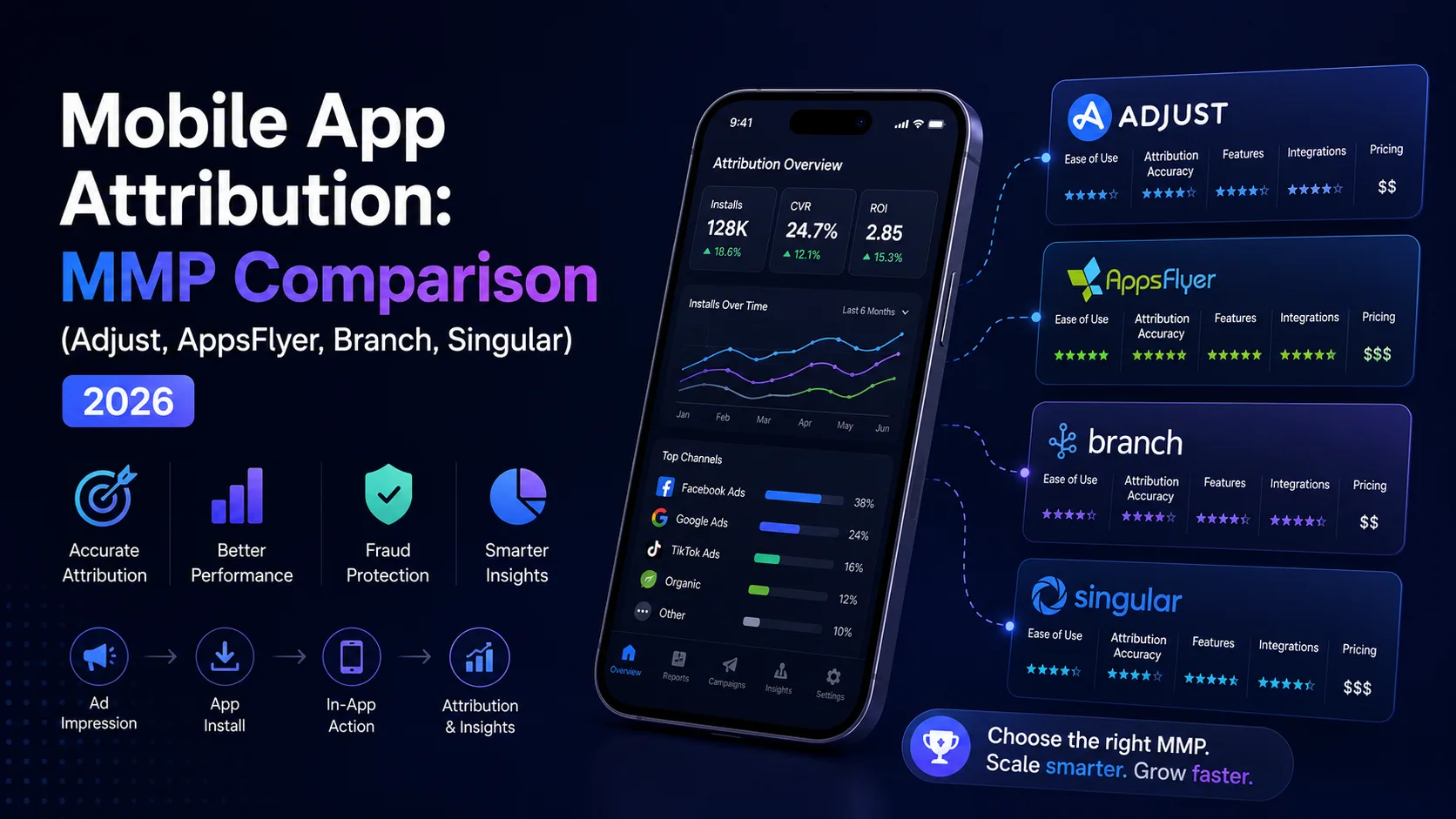
The Mobile Measurement Partner (MMP) is the boring-but-decisive piece of infrastructure that determines whether your paid acquisition spend actually works in 2026. Apple's ATT framework collapsed traditional user-level attribution starting in 2021, leaving most apps with 70–80% iOS opt-out rates and SKAdNetwork postbacks as the new standard. Your ad networks (ASA, GAC, Meta, TikTok) each report their own version of "your campaign succeeded" — and they each over-credit themselves. The MMP is the neutral third party that deduplicates competing attribution claims, decodes SKAdNetwork conversion values, and tells you which channel actually drove the install. Pick the wrong MMP and you'll spend $50,000 on a channel that doesn't deserve credit and never run that experiment again. Pick the right MMP and you'll see exactly which ad network is profitable, down to the creative variant. This is the operator-level guide for indie developers in 2026: what each major MMP actually does well, the free tiers that work for early-stage apps, the migration cost when you pick wrong, and the specific MMP choice for different app profiles (subscription apps, games, deep-linking-heavy apps, multi-channel paid).
What an MMP actually does
The MMP solves three problems no single ad network can solve:
- Deduplication of attribution claims. Every ad network (ASA, GAC, Meta, TikTok, AppLovin, Unity) reports installs it claims credit for. The same install can be claimed by 3+ networks. The MMP is the neutral arbiter that assigns each install to one channel based on first-touch, last-touch, or multi-touch rules.
- SKAdNetwork postback decoding. Apple's privacy-preserving framework sends conversion data in encoded postbacks. MMPs ingest these, decode the conversion values, and reconstruct campaign-level attribution. Without an MMP, you see raw SKAN postbacks; with one, you see actionable per-campaign performance.
- Cross-channel ROI comparison. Without a single source of truth, you can't compare Meta's reported ROAS to TikTok's reported ROAS — each platform's calculation is different and self-interested. The MMP normalizes everything to the same definition, making cross-channel decisions possible.
Modern MMPs also handle deep linking (deferred links from ads, email, web), fraud prevention (detecting click spam, install hijacking, attribution fraud), audience segmentation (sending behavior data back to ad networks for targeting), and cost aggregation (pulling spend data from each platform). The core job, though, remains attribution — turning noisy multi-source signals into one credible answer for "which channel produced this install."
The five MMPs that matter in 2026
Hundreds of attribution tools exist, but five MMPs control roughly 90% of serious mobile app paid acquisition:
- AppsFlyer: The market leader. Founded 2011. Broadest ad network coverage (8,000+ partner integrations). Strongest SKAdNetwork support. Default choice for most apps because every ad network supports it best. Zero (free up to 12,000 monthly attributions), Growth (paid), Enterprise tiers.
- Adjust: Berlin-headquartered. Strong on fraud prevention, automation, and GDPR-native privacy posture. Popular with European apps and gaming studios. Lighter SDK than AppsFlyer. Custom pricing; Starter tier available with limited features.
- Branch: Deep linking specialist that expanded into attribution. Best-in-class deep linking and web-to-app flows. 100,000+ apps including TikTok, Shopify, BuzzFeed. Generous free tier — the indie-friendly entry point. Less deep on advanced attribution analytics than AppsFlyer or Adjust.
- Singular: Cost aggregation + ROAS analytics specialist. Combines marketing spend data with attribution, giving true ROI reporting by channel, campaign, and creative. AI-powered budget recommendations and cost anomaly alerts added in 2026. Free tier includes revenue attribution (rare feature). Generally 20–40% cheaper than AppsFlyer or Adjust at comparable volume.
- Kochava: Configurable attribution with strong data ownership tools. Flexible enterprise pricing. Strong in gaming. Less plug-and-play than competitors but more customizable for data-savvy teams.
Two newer players worth mentioning: Airbridge (subscription app specialist, emerging 2024–2026) and Tenjin (hyper-casual gaming focus). For most indie developers in 2026, the choice is between AppsFlyer, Adjust, Branch, and Singular — covered in depth below.
The honest comparison: head-to-head
Line by line, what each MMP offers indie developers in 2026:
- Free tier availability: AppsFlyer Zero (up to 12K monthly attributions). Branch (generous free). Singular (free with revenue attribution). Adjust Starter (limited). Kochava (free).
- SKAdNetwork support: AppsFlyer, Adjust, Singular, Kochava — all strong. Branch — full support added in 2024 but lighter than competitors.
- Ad network integration count: AppsFlyer 8,000+ (broadest). Adjust 4,000+. Singular 1,000+. Branch 1,000+. Kochava 3,000+.
- SDK size: Adjust (lightest). Branch (light, deep-linking focused). Singular (mid). AppsFlyer (heaviest, most features).
- Deep linking: Branch (best-in-class). All others competent but less polished.
- Fraud prevention: AppsFlyer and Adjust lead. Singular and Branch competent. Kochava configurable.
- Subscription tracking: Singular and AppsFlyer strong. Airbridge purpose-built. Adjust and Branch require configuration.
- Cost aggregation (true ROAS): Singular (best-in-class). AppsFlyer adequate. Others require external setup.
- European data residency: Adjust (Berlin, GDPR-native). Others have EU options but Adjust is most aggressive on privacy posture.
- Pricing transparency: Branch most transparent. AppsFlyer published Zero tier with clear caps. Others custom enterprise quotes — opaque until you negotiate.
- Pricing at $100K monthly paid spend: Singular typically 20–40% cheaper than AppsFlyer/Adjust at this volume. Branch competitive. Kochava custom but often competitive.
- Time to implement: Branch fastest (especially if deep linking is your primary need). AppsFlyer mid. Adjust mid. Singular mid. Kochava slower (more configuration required).
- Documentation quality: AppsFlyer best documented. Adjust strong. Singular adequate. Branch good for linking, lighter on attribution. Kochava more technical, less hand-holding.
- Customer support for indies: Branch generally most accessible. AppsFlyer support strong even on Zero tier. Adjust and Singular require larger spend for premium support.
The indie developer decision framework
Rather than "which MMP is best," ask which fits your specific situation:
Pick AppsFlyer if:
- You're starting paid acquisition for the first time and want the safest default.
- You need maximum ad network coverage (especially long-tail networks).
- Your monthly attribution volume fits the Zero tier (~12K/month).
- You value extensive documentation and ecosystem support.
- You may scale to $50K+ monthly paid spend within 12 months.
Pick Adjust if:
- You're European-focused or GDPR-sensitive.
- You're building a gaming app (Adjust has strong gaming ecosystem).
- Fraud prevention is a critical concern (you're buying from higher-risk networks).
- You want the lightest SDK footprint for performance reasons.
- You have technical capacity to handle Adjust's automation features.
Pick Branch if:
- Deep linking is core to your acquisition strategy (web-to-app, email-to-app, referral programs).
- You're early-stage and need a generous free tier.
- Your attribution complexity is modest (mainly install + a few key events).
- You value implementation speed over analytics depth.
- You're running referral programs or cross-channel journeys.
Pick Singular if:
- You're a subscription app focused on LTV and ROAS optimization.
- You need cost aggregation across many channels (true cross-channel ROI).
- You're paid-spend-heavy and want 20–40% MMP cost savings vs leaders.
- You value AI-driven budget recommendations and anomaly alerts.
- You're scaling past $50K monthly paid spend across multiple channels.
If none of these specific situations apply, default to AppsFlyer Zero. It's the safest first choice for most indie developers in 2026 and scales to most use cases without forcing migration.
The free tiers that actually work for indies
For early-stage indies, the free tier matters more than feature parity. The honest 2026 free-tier comparison:
- AppsFlyer Zero: Up to 12,000 monthly attributions free. Includes core attribution, fraud filtering, SKAdNetwork support, deep linking basics. Limits: limited custom event tracking, basic reporting. Best for: most indies under 12K monthly installs.
- Branch Free: Generous free tier covering attribution and full deep linking. Limits: advanced analytics gated behind paid plans. Best for: deep-linking-heavy apps under 250K monthly active users.
- Singular Free: Includes revenue attribution — rare among free tiers. Limits: advanced cost aggregation gated. Best for: subscription apps prioritizing revenue measurement on a budget.
- Adjust Starter: Limited free tier. More restrictive than competitors for early-stage. Best for: testing Adjust before committing to paid plan.
- Kochava Free: Available with attribution basics. Limits: requires configuration; less indie-friendly out of the box. Best for: technical teams wanting data ownership.
For most indies running their first paid acquisition campaigns under $5K/month total spend, the AppsFlyer Zero tier or Branch Free tier covers the use case completely. Don't pay for an MMP before you need it.
The pricing reality at scale
MMP costs grow with paid acquisition volume. The 2026 economics:
- $0–$5K/month paid spend: Free tiers cover everything. AppsFlyer Zero or Branch Free is sufficient.
- $5K–$25K/month paid spend: May exceed free tier limits. Expect $200–$800/month MMP cost. AppsFlyer Growth, Branch Growth, or Singular Standard.
- $25K–$100K/month paid spend: Custom pricing territory. Expect $1,000–$5,000/month MMP cost. All four major MMPs negotiable; Singular often 20–40% cheaper than AppsFlyer/Adjust at this volume.
- $100K+/month paid spend: Enterprise pricing. Expect $5,000–$20,000+/month. Negotiate aggressively; ask about annual commits, regional rates, and feature gating.
The MMP cost should sit around 1–3% of paid acquisition spend. If it's exceeding 5%, you're either over-paying or your paid acquisition isn't scaled yet (which is fine — use free tiers).
Subscription apps: the special case
Subscription apps have specific MMP requirements that not all platforms handle well:
- Trial-to-paid attribution. Connecting the install → trial start → trial conversion → first renewal across the full funnel. Singular and AppsFlyer handle this natively; Branch requires configuration.
- Cohort LTV measurement. Subscription value compounds over months. MMPs need to track cohort revenue beyond Day 30. All four major MMPs support this but Singular and AppsFlyer have stronger out-of-box reporting.
- Subscription event integration. RevenueCat, Adapty, Qonversion send subscription events to MMPs. Verify integration depth before committing — some MMPs require manual setup.
- Refund and churn attribution. Subscription apps need to track refunds and renewals as separate events. MMPs vary in how well they handle non-purchase events.
For subscription apps specifically, Singular and AppsFlyer are the strongest choices in 2026. Airbridge is also worth evaluating as the newer purpose-built option. Branch and Adjust work but require more configuration.
For the subscription business fundamentals that determine your acquisition LTV ceiling, see our subscription pricing guide and subscription churn guide.
Gaming apps: the other special case
Mobile games have specific MMP requirements that differ from subscription apps:
- In-app economy tracking. Games measure soft and hard currency events, level completion, tutorial steps. MMPs vary in how cleanly they handle high-event-volume tracking.
- Ad revenue attribution. Games with rewarded ads need impression-level revenue tracking from networks like AppLovin, ironSource, Unity. Adjust and AppsFlyer handle this strongest; Tenjin is purpose-built for hyper-casual gaming.
- Ad LTV reporting. The combination of IAP revenue + ad revenue per user. Singular and Tenjin lead here.
- Player-quality cohort analysis. Long-term retention by acquisition source. All major MMPs support but require setup.
For gaming apps, Adjust (general gaming), Singular (ROI optimization), or Tenjin (hyper-casual specifically) are the strongest 2026 choices.
SKAdNetwork integration: the new attribution reality
Apple's SKAdNetwork (SKAN) framework, introduced in 2021 and now at version 4.0, fundamentally changed iOS attribution. The MMP's role in 2026:
- SKAN postback ingestion. Apple sends encoded postback messages with limited conversion data. MMPs ingest and decode these.
- Conversion value configuration. SKAN provides a small conversion value (6 bits in SKAN 4.0). MMPs help you configure what this represents — install, registration, purchase tier.
- Postback aggregation. SKAN sends data in delayed batches (24–72 hour windows). MMPs aggregate across campaigns and time windows.
- Cross-method blending. SKAN data + deterministic Android data + probabilistic modeling. MMPs blend these into unified reporting.
- Modeled conversions. For low-volume campaigns where SKAN privacy thresholds suppress data, MMPs use statistical models to estimate conversions.
All five major MMPs support SKAN in 2026, but the quality of conversion value configuration tools and modeled conversion algorithms varies. AppsFlyer and Singular lead on SKAN sophistication; Adjust strong on automation; Branch competent; Kochava configurable.
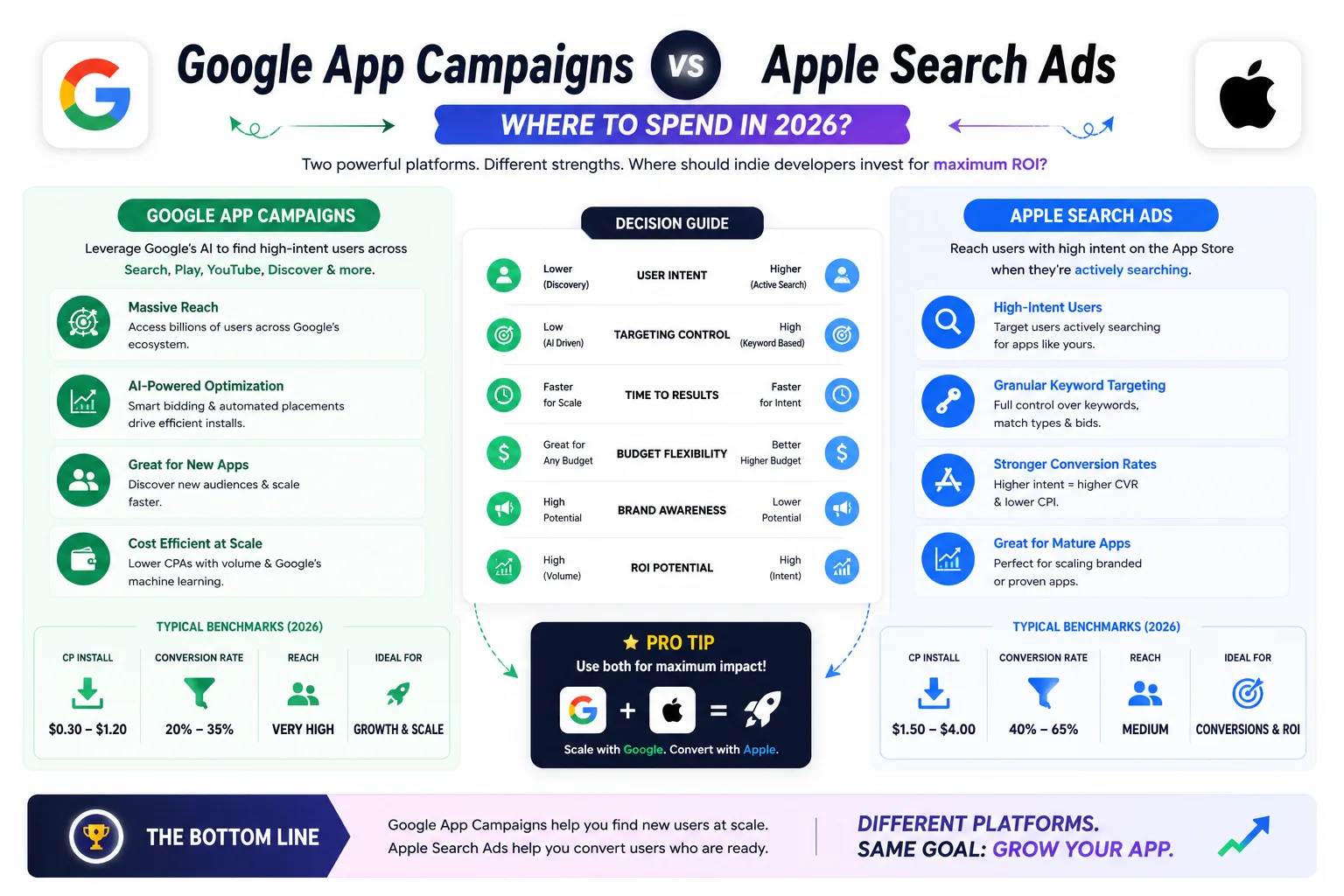
For the broader iOS attribution context, our paid acquisition guides cover platform-specific implications: Apple Search Ads ROI, GAC vs ASA, Meta Ads, and TikTok Ads.
Migration: the cost of picking wrong
Switching MMPs is painful. Historical attribution data does NOT transfer between MMPs. When you migrate:
- You lose historical data. Cohort LTV calculations restart from zero. Year-over-year comparisons break.
- You re-integrate every ad network. Each network's MMP integration must be reconfigured. Some take weeks.
- SDK changes ship in your app. Remove old MMP SDK, add new MMP SDK, submit new app version, wait for adoption. Takes 30–60 days for full coverage.
- Reporting comparisons break during transition. 30–60 days of dual-MMP running needed for confidence.
For most indie apps, this means: pick your MMP carefully once, and stick with it for 18–24 months minimum. The opportunity cost of staying with a moderately-suboptimal MMP is usually smaller than the migration cost of switching to a marginally-better one.
When migration IS warranted: 10x scale changes (your monthly paid spend has grown 10x and pricing has compressed), strategic feature gaps (you need subscription LTV reporting and your current MMP lacks it), or major reliability issues with current vendor.
Common implementation mistakes
Patterns that consistently undermine MMP value across indie apps:
- Implementing two MMPs simultaneously. Two SDKs in one app create competing attribution claims internally. Pick one.
- Skipping conversion value configuration. SKAN postbacks are useless without conversion value schema configured. Spend a week setting this up properly.
- Not configuring deep linking. Acquisition campaigns lose context without deferred deep links. Configure them at launch.
- Forgetting Events API for Meta and TikTok. MMP attribution alone isn't enough for Meta/TikTok iOS optimization in 2026. Server-side events via CAPI / Events API + MMP attribution is the standard stack.
- Optimizing on Install attribution alone. Move to post-install event optimization (registration, purchase) once you have 100+ events per channel per week. The MMP enables this; failing to use it leaves money on the table.
- Not tracking cohort LTV. Day 1 ROAS lies. Day 30 ROAS is closer to truth. Day 180 ROAS is the answer. Configure cohort tracking from day one.
- Ignoring fraud filters. AppsFlyer and Adjust have strong fraud filtering; turn it on. Without it, click spam and install hijacking inflate your reported volume and waste budget.
- Negotiating pricing once and never revisiting. MMP pricing compresses over time; renegotiate annually as your volume grows.
Frequently asked questions
Do I really need an MMP if I'm only running ASA?
Strictly no — Apple Search Ads provides native attribution. But you'll struggle the moment you add a second channel (GAC, Meta, TikTok). MMPs solve cross-channel measurement, which becomes essential at 2+ paid channels. Start free with AppsFlyer Zero or Branch from day one.
What's the minimum spend before MMP pays for itself?
Free tiers cover the under-$5K/month range for most apps. Paid MMP plans ($200–$800/month) pay for themselves at $10K+/month paid spend through improved channel mix decisions. Below that volume, free tiers are sufficient.
Should I implement multiple MMPs in parallel?
No. Two MMPs create attribution conflicts and double your SDK overhead. Pick one. The only exception is a 30–60 day parallel run during migration, then remove the old one.
How long does MMP implementation take?
Basic integration (SDK + install attribution): 1–3 days. Full setup (conversion values, deep links, all events): 2–4 weeks for thorough implementation. Branch fastest; Kochava slowest.
Can I switch MMPs after launching?
Yes, but historical data doesn't transfer. Plan 30–60 days of parallel running, lose cohort comparisons, and re-integrate every ad network. Avoid switching unless strategically necessary.
Which MMP is cheapest at scale?
Singular is consistently 20–40% cheaper than AppsFlyer or Adjust at $100K+ monthly paid spend. Branch can be competitive depending on use case. Kochava custom but often competitive. AppsFlyer and Adjust price most aggressively at very high enterprise volume.
Do I need an MMP if I only have an Android app?
Android attribution is cleaner than iOS (deterministic identifiers more available), but you still benefit from MMP cross-channel deduplication. Free tiers cover most cases. Branch is strong for Android-first apps.
What's the difference between MMP and analytics platforms like Mixpanel or Amplitude?
MMPs handle acquisition attribution (which channel produced this install). Product analytics (Mixpanel, Amplitude) handle in-app behavior analysis. Both are useful; they serve different jobs. Most apps use one of each.
Does my MMP work with RevenueCat or Adapty for subscription tracking?
All major MMPs integrate with RevenueCat, Adapty, and Qonversion. Verify integration depth before committing — some integrations are robust, others require more setup. RevenueCat's documentation explicitly lists their supported MMPs.
How does MMP attribution work with App Store and Play Store pre-install fraud?
MMPs have fraud filters that detect click spam, install hijacking, and bot installs. AppsFlyer and Adjust have the strongest fraud detection. Turn fraud filters on; the false-positive rate is low and the filtered fraud is meaningful.
The bottom line
The MMP is the infrastructure layer that turns paid acquisition spend from "I think Meta is working" into "Meta produced 312 installs at $1.83 CPI with 14% Day 30 conversion to subscription." Five MMPs control the 2026 market — AppsFlyer (default leader), Adjust (privacy + gaming), Branch (deep linking + indie-friendly), Singular (cost aggregation + subscription apps), and Kochava (configurable enterprise). For most indie developers starting paid acquisition: AppsFlyer Zero or Branch Free covers your first 12 months. As you scale past $25K monthly paid spend, evaluate the upgrade based on your specific app profile — subscription apps lean Singular or AppsFlyer; gaming apps lean Adjust or Singular; deep-linking-heavy apps lean Branch. Pick once, stick with it for 18–24 months minimum, and don't migrate unless strategically necessary. The MMP cost should sit at 1–3% of your paid acquisition spend; if it's higher, you're either overpaying or you're not scaled enough to need premium tier.
The MMP is the technical foundation underneath the paid acquisition portfolio. For the channel-specific guides: Apple Search Ads ROI, GAC vs ASA allocation, Meta Ads for app install, and TikTok Ads for apps. For the LTV math that determines your maximum sustainable CPI on any channel, the subscription pricing guide covers pricing and the churn guide covers retention. And for the ASO foundation that drops your blended CPI by improving organic conversion, the complete ASO guide ties everything together.
Related posts
Make your App Store screenshots free
LaunchShots is a free, in-browser screenshot maker. No signup, no watermark.
Open the app →
Comments (0)