App Subscription Churn 2026: Why 40-60% Cancel in Month 1
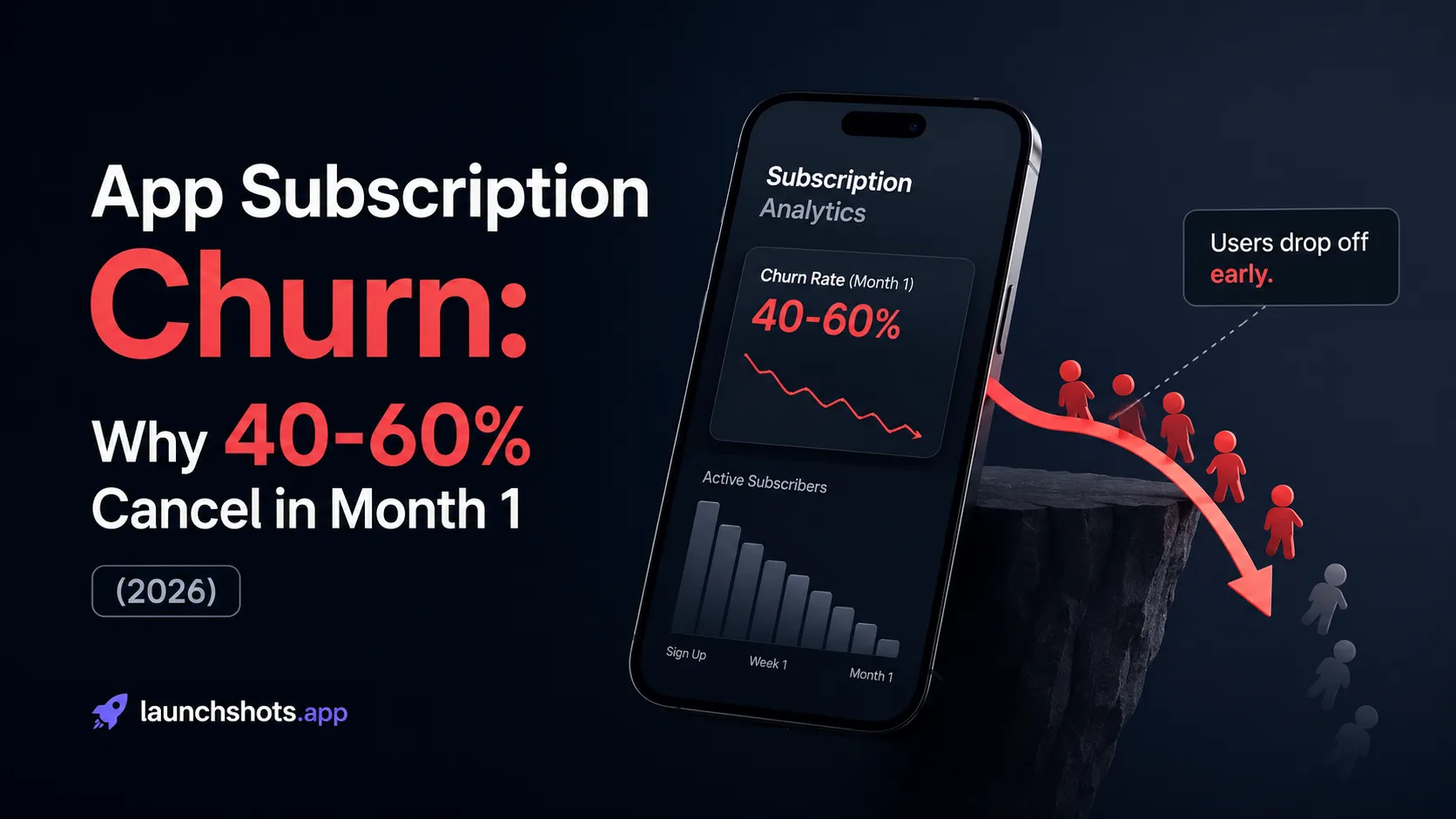
Most indie subscription apps lose 40–60% of new subscribers within the first 30 days — and the depth of that loss determines whether the app reaches sustainable LTV or quietly bleeds out over a year of declining cohorts. RevenueCat's 2026 State of Subscription Apps report, drawn from 115,000+ apps and over a billion transactions, exposes the brutal math: 35% of all annual cancellations happen in Month 1, 31% of Google Play cancellations are involuntary billing failures, 55% of 3-day trial cancellations happen on Day 0, and AI-powered apps churn 30% faster than non-AI apps despite 52% higher trial-to-paid conversion. Most indie developers treat Month 1 churn as "users just didn't like the app" — the data says otherwise. The single largest preventable cause is billing infrastructure, the second is onboarding that doesn't deliver value in the first session, and the third is wrong plan structure for the category. This is the operator-level guide to subscription churn in 2026: where Month 1 cancellations actually come from, the categories with the highest and lowest churn, the specific interventions that recover involuntary churn, and the framework for cutting Month 1 churn from 50% to 20% within 90 days.
Where Month 1 churn actually comes from
The first thing to understand is that "churn" isn't one thing — it's at least four different things, with very different fixes:
- Voluntary churn (user actively cancels): The user opened settings, navigated to subscriptions, and tapped cancel. They made a deliberate decision. Fix: product value, expectations management, pricing.
- Trial expiration churn (user lets trial expire without converting): The user never converted to paid. May or may not have explicitly canceled — Apple and Google handle this differently. Fix: trial experience design, value demonstration timing.
- Involuntary churn (billing fails): Credit card expired, declined, or the payment method got removed. The user often doesn't know they churned. Fix: billing infrastructure, dunning, grace periods.
- Refund-driven churn: The user got their money back after subscribing. Counts as churn in revenue terms even though the subscription technically existed. Fix: pre-purchase clarity, onboarding alignment with expectations.
The 2026 data shows these aren't equally distributed across stores or categories. Google Play has dramatically more involuntary churn than the App Store. Health & Fitness has dramatically more trial expiration churn than Business. Productivity has more voluntary cancellations after Month 1 than other categories. Generic "reduce churn" advice ignores this — the right intervention depends on which type dominates your specific app.
The Month 1 numbers: what's actually happening
The hard data from 2026 cohort studies:
- 35% of annual subscriptions are canceled within Month 1. Across all categories. Users treat annual subscriptions as one-time purchases, not 12-month commitments — they pay, then immediately protect their wallet.
- 50% of Shopping app annual subscribers cancel within Month 1. The highest cancellation rate of any category for annual plans.
- 55% of 3-day trial cancellations happen on Day 0. Same session as the trial start. The user signs up, looks around for a few minutes, and cancels before leaving.
- 31% of Google Play cancellations are involuntary billing failures. Nearly a third of "churn" on Android isn't users who didn't want the app — it's credit cards that expired or failed. This is reclaimable revenue.
- 14% of App Store cancellations are involuntary billing failures. Apple's payment infrastructure is more robust, but 1-in-7 cancellations is still significant.
- Mobile apps generally lose 70–80% of users within 30 days of install, 95%+ within 90 days. This includes free non-subscribers who never planned to monetize, but the pattern compounds the subscription churn problem.
The implication: if you measure overall "churn" as a single number, you're hiding three or four different problems with different solutions. Break out voluntary vs involuntary vs trial expiration vs refunds. Treat each separately.
Why annual subscribers cancel so fast
A counter-intuitive finding from 2026 data: annual subscribers are not "12-month users." They behave more like one-time buyers who paid annually for the discount.
What the data shows:
- Annual subscribers cancel auto-renewal in Month 1 because they're protecting future spend. They paid for this year; they don't want to be billed automatically next year.
- Annual reactivation rate is just 5% within one year of canceling. Once they leave, they don't come back at scale.
- Monthly subscribers come back at 4x the rate (around 20%). Counter-intuitively, "easier to cancel" monthly plans produce more reactivation opportunities.
- Annual plans renew at 83.4% once a user makes it to renewal. But "making it to renewal" requires not canceling in Month 1, Month 6, or Month 11.
- Subscribers who survive their first annual renewal renew at 44–64% the second year, then 56–70% the third. Once they prove they want the product, they tend to stay.
The implication: the goal with annual subscribers isn't to "convert them well" at sign-up. It's to prevent the Month 1 auto-renewal cancellation. Once they don't cancel in Month 1, the rest of the cohort math improves dramatically.
Involuntary churn: the $129 billion industry leak
The single biggest unclaimed revenue opportunity in subscription apps in 2026 is involuntary churn from billing failures. The industry lost $129 billion in 2025 to failed payments. Google Play's billing failure rate worsened from 28.2% in 2025 to 31% in 2026; the App Store improved slightly to 14%.
What causes involuntary churn:
- Card expiration. User signed up 11 months ago with a card that expired this month. Auto-renewal fails.
- Card declined. Insufficient balance, fraud filter triggered, or issuer rejected the recurring charge.
- Card removed from store account. User deleted their payment method or it was replaced.
- Country/billing address changes. User moved, payment method no longer valid for the original region.
- Card replaced after fraud. Issuer canceled the old card and issued a new one; the user never updated it in App Store/Play settings.
The recovery levers:
- Enable grace periods on Google Play. Default grace period is 0 days — failed payment immediately ends the subscription. Configure 3, 7, or 14 day grace periods so users have time to update billing without losing access.
- Configure dunning retry logic. Apple and Google both retry failed payments automatically, but you can customize the retry cadence in Play Console. More aggressive retries recover 5–15% of involuntary churn.
- Send in-app billing prompts. When detecting a failed payment, show in-app messaging directing users to update their billing method. Most users will fix it if asked; few notice on their own.
- Run reactivation campaigns for involuntary churners. Different from voluntary churners — these users wanted to keep their subscription but didn't know it ended. Reactivation rates can hit 30–50% with the right outreach.
The math: if you have 1,000 monthly subscribers on Google Play and 31% are churning involuntarily, that's 310 subscribers per month bleeding out for purely technical reasons. Recovering even half of those is a 15% MRR improvement — without acquiring a single new user. This is the highest-ROI growth intervention available to Android-heavy apps in 2026.
The Day 0 trial cancellation problem
55% of all 3-day trial cancellations happen on Day 0 — the same session as the trial start. Users sign up, look around for 3–8 minutes, decide it's not for them, and cancel before they ever return.
What this tells you:
- Trial length doesn't matter as much as you think. Most decision-making happens immediately. Extending from 3 days to 14 days doesn't give users "more time to fall in love" — it gives the ones who would have canceled more time to forget.
- Day 0 onboarding is the entire trial. Whatever your app shows in the first session determines retention more than any other lever.
- "Aha moment" timing is everything. Users need to experience clear value in the first session. If your aha moment is buried at session 3, you've lost the user before they get there.
The interventions that work:
- Map your aha moment. What's the single action that, once a user does it, makes them want to come back? For habit trackers, it's checking off the first habit. For photo apps, it's saving the first edit. For language learning, it's completing the first lesson. Identify yours.
- Engineer the first session to reach the aha moment. Cut every step that delays it. Move onboarding screens after the value, not before. Skip account creation if possible.
- Don't require sign-up before value. Apple's guidelines increasingly require "guest mode" for content browsing. Use it. Let users experience value first, sign in later.
- Pre-fill defaults aggressively. Don't ask users to configure 8 settings before seeing the app work. Start with sensible defaults; let them customize after they're hooked.
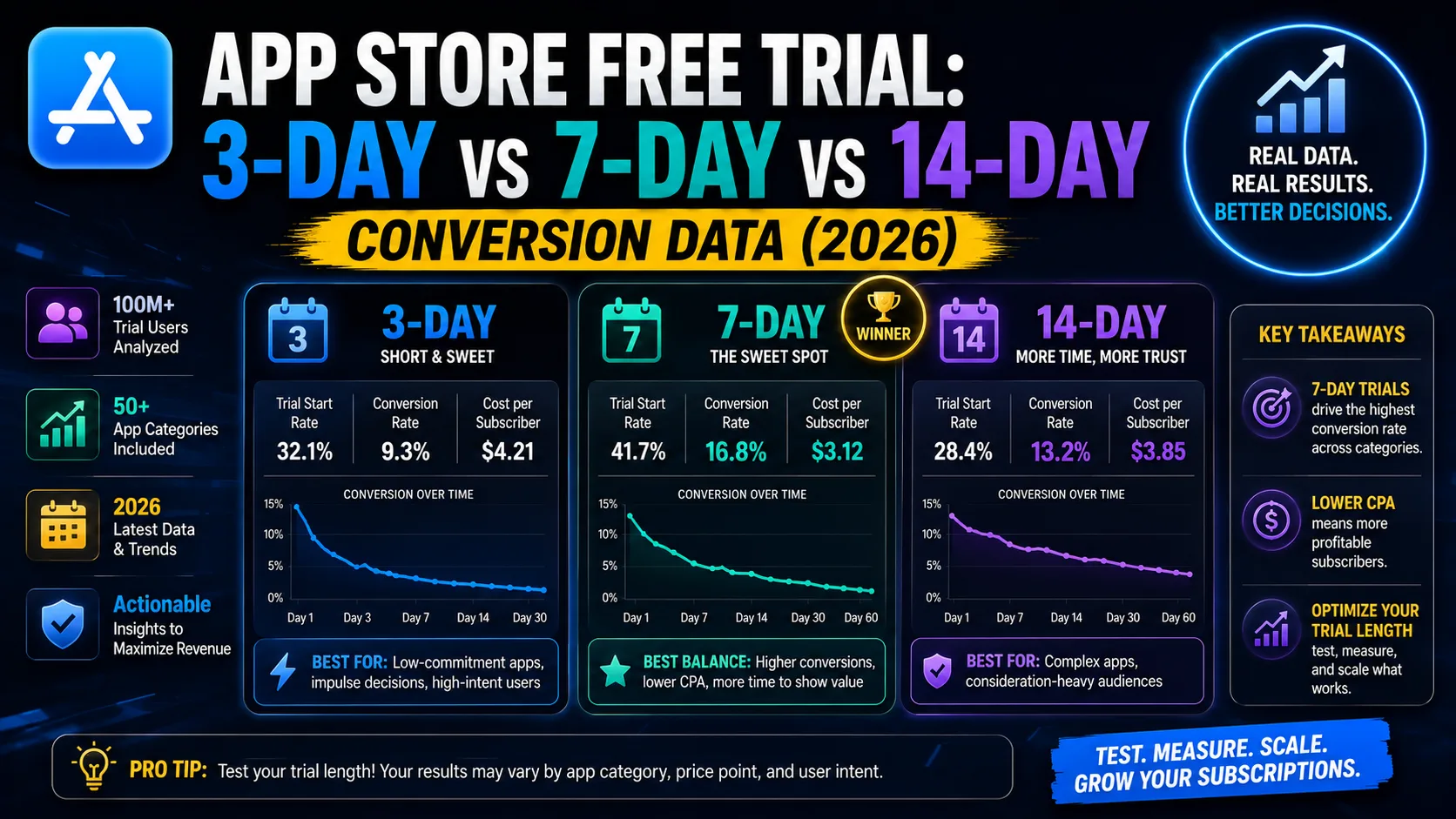
For more on trial design specifically, our free trial length guide covers the 3 vs 7 vs 14 day data and the framework for picking the right duration.
Retention by category: the 19-point spread
RevenueCat's 2026 data shows annual renewal rates vary by 19 percentage points across categories — bigger than the spread between regions or plan durations. The category-level reality:
- Business apps: Highest retention. 61% monthly, 40% annual. Once an app becomes critical infrastructure, churn drops.
- Travel apps: 40% annual (highest), but 53% monthly and 48% weekly. Long-term commitment without habitual engagement.
- Media & Entertainment: 58% monthly, 37% annual, 45% weekly. Content consumption favors longer billing cycles.
- Utilities: 58.1% first-renewal retention. Users get into a habit and stay.
- Health & Fitness: 54% weekly (top tier), 57% monthly (mid-tier), 25% annual (mid-tier). Goal-driven category — users churn when they hit or miss their goals.
- Productivity: 50–55% monthly. Strong for habits, weaker for tool-based use cases.
- Education: Strong mid-tier. Users churn when they finish what they came for.
- Shopping: 50% Month 1 annual cancellation rate — highest in the dataset. Discount-driven sign-ups don't translate to renewals.
- Social & Lifestyle: Lowest retention rates across weekly and monthly plans. High churn, hard to sustain.
The implication: your category's baseline matters. A 40% monthly churn rate in Social & Lifestyle is average. A 40% monthly churn rate in Business is a crisis. Benchmark against your category, not against B2B SaaS or against blended mobile app averages.
AI apps: 30% faster churn despite 52% better conversion
One of the most striking findings from 2026 data: AI-powered apps convert trials to paid 52% better than non-AI apps (8.5% vs 5.6% median), but they churn 30% faster (annual retention 21.1% vs 30.7%, monthly retention 6.1% vs 9.5%).
The pattern:
- AI hype creates initial sign-ups. Users want to try the latest AI feature. Conversion is strong.
- AI thin wrappers don't deliver lasting value. Users sign up, try the AI, see it's similar to ChatGPT, and cancel.
- AI refund rates are 20% higher. 4.2% vs 3.5% median; upper bound 15.6% vs 12.5%. Users actively ask for money back.
- AI ARPU is 41% higher in early months. The early money is real; it just doesn't last.
The implication for indie AI app builders: don't rely on AI hype to sustain LTV. Build genuine product value around the AI features. The apps winning with AI in 2026 are the ones with opinionated vertical products that get better as the underlying models improve — not thin LLM wrappers monetizing curiosity.
The interventions that cut Month 1 churn
The playbook that consistently reduces Month 1 churn by 30–50% across categories:
- Fix involuntary churn first. Enable Google Play grace periods (7–14 days). Configure aggressive dunning. Run in-app billing prompts when retries fail. Highest ROI lever for Android apps. Easy 5–15% MRR recovery.
- Redesign Day 0 to reach the aha moment. Audit your first-session flow. Cut every step that delays the moment of value. Most apps can compress 3 sessions of value discovery into the first session with deliberate redesign.
- Send a Day 1 push notification re-engaging non-returners. Users who don't return on Day 1 churn dramatically more. A simple "Here's something cool you can try" notification recovers 5–10%.
- Send a trial-end-1-day reminder. The night before the trial ends is the highest-conversion moment. Custom reminders outperform Apple/Google's automatic ones by 15–25%.
- Set up a cancel-flow with offers. When users tap "cancel subscription," show a one-time discount, plan downgrade, or pause option. 15–30% of cancellers take the offer.
- Run reactivation campaigns 30 days post-churn. Reactivation rates are highest within the first 90 days after churn. After that, they drop dramatically.
- Audit your category benchmark. If you're below your category median, focus on product. If you're at category median, focus on involuntary churn and Day 0. If you're above category median, focus on Month 2–6 retention (the next leak).
- Map plan duration to category behavior. Gaming apps that ship 82% weekly subscriptions are right; Productivity apps that ship 77% monthly are right; Health & Fitness apps that ship 68% annual are right. Match your category's behavior pattern.
The mistakes that quietly increase churn
Patterns that consistently make Month 1 churn worse:
- Treating churn as a single number. Voluntary, involuntary, trial expiration, and refund have different causes and different fixes. Track each separately.
- Ignoring Google Play involuntary churn. 31% is the number. If you're Android-heavy and not optimizing dunning, you're losing 30% of cancellations to fixable technical problems.
- Asking for too much info before delivering value. Users who never reach the aha moment churn immediately. Sign-up walls before value = high churn.
- Defaulting to 7-day trials without category data. Some categories benefit from longer trials; some perform better with no trial at all.
- Hiding the cancel button. Users who can't easily cancel leave 1-star reviews. The short-term LTV gain from manipulation is dwarfed by the brand damage.
- Comparing churn against B2B SaaS benchmarks. Mobile churn operates on a completely different scale. A 5% monthly churn rate is unicorn territory in B2C mobile apps.
- Skipping cancel-flow offers. Showing a one-time discount or pause option to cancelling users recovers a meaningful percentage at near-zero cost.
- Not running reactivation. Users who churned within the last 90 days are your highest-converting reactivation cohort. After 90 days, the opportunity narrows dramatically.
- Optimizing acquisition without optimizing retention. A leaky bucket doesn't fill faster with more water. Fix the bucket first.
Frequently asked questions
What's the average Month 1 churn rate for subscription apps?
Roughly 35% of annual subscriptions are canceled in Month 1 across all categories. Monthly subscriptions vary widely by category — 17% baseline for monthly plans, much higher for short-trial cohorts. Compare to your category median, not blended averages.
Why is Google Play involuntary churn so much higher than App Store?
Google Play's billing infrastructure has less robust retry logic and grace period defaults. Cards expire, decline, or get replaced more often without recovery flows kicking in. Apple's billing layer is more robust. The fix: configure Play Console grace periods and dunning retries aggressively.
Can I reduce Month 1 churn without changing my product?
Yes — significantly. Involuntary churn fixes (grace periods, dunning, in-app billing prompts) require no product change and can recover 5–15% MRR. Day 0 onboarding redesign and cancel-flow offers similarly improve numbers without core product changes.
What's the difference between voluntary and involuntary churn?
Voluntary churn: the user actively decided to cancel. Involuntary churn: billing failed for technical reasons (card expired, declined, removed). The user didn't make the decision to leave; the system ended their subscription. Different causes, different fixes.
How do I know my category's churn benchmark?
RevenueCat's State of Subscription Apps 2026 report and Adapty's State of In-App Subscriptions 2026 both publish category-by-category breakouts. Compare against your specific category, not generic averages.
Are annual plans really worth pushing?
Yes — once users make it past Month 1. Annual plans renew at 83.4% (vs 17% monthly, 5.5% weekly). But Month 1 cancellation is high (35% annual cancel in Month 1). The math improves dramatically if you can prevent the immediate auto-renewal cancellation.
What's the ROI of reducing involuntary churn?
For Google Play apps, recovering 50% of involuntary churn is roughly a 15% MRR improvement. The fix costs near-zero engineering time — grace period and dunning configuration. Highest-ROI growth lever for Android-heavy apps in 2026.
Should I run a cancel-flow offer?
Yes for most apps. 15–30% of users who reach the cancel button will accept a one-time discount, pause, or plan downgrade. Apple and Google both allow this — they just require the cancel option to be clearly available.
How long do users stay churned before reactivation gets hard?
Reactivation rates are highest within the first 30–90 days post-churn. Annual subscribers reactivate at just 5% within one year, while monthly subscribers come back at 4x that rate (around 20%). Run reactivation campaigns within the first 90 days post-churn for best results.
What's the relationship between churn and pricing?
Counter-intuitively, lower-priced apps retain better on annual plans (36% vs 23% for high-priced). At the monthly level the gap is smaller. High prices filter for higher-intent users, but they also produce higher churn from buyer's remorse. There's no universal answer — test by category.
The bottom line
Month 1 subscription churn isn't a single problem — it's at least four: voluntary cancellation, trial expiration, involuntary billing failures, and refunds. Each has different causes and different fixes. The largest unclaimed revenue opportunity in 2026 is involuntary churn on Google Play, where 31% of cancellations are billing failures recoverable through grace periods, dunning, and in-app billing prompts. The second-largest is Day 0 trial cancellations, where 55% of users decide to leave within minutes of signing up — reachable only through Day 0 onboarding redesign and aha-moment engineering. The third is wrong plan structure for the category, where matching duration to user behavior (weekly for gaming, monthly for productivity, annual for health) compounds retention over years. Cut Month 1 churn from 50% to 20%, and the rest of your subscription math becomes dramatically more sustainable. Most indie apps leave 30–40% of MRR unclaimed on these levers alone.
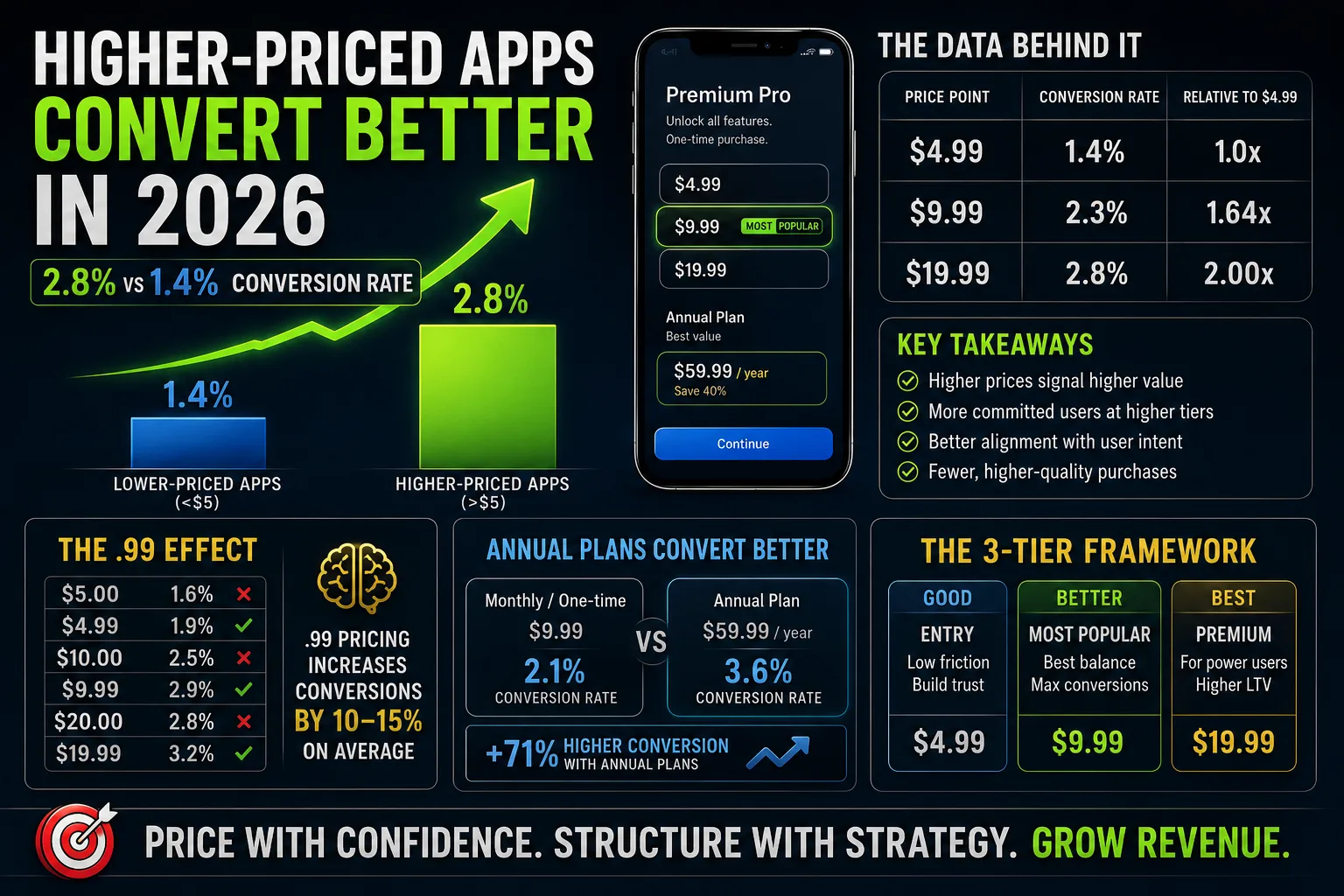
Churn is one piece of the broader subscription stack. Our subscription pricing guide covers the $4.99 vs $9.99 vs $19.99 math and the 3-tier framework that determines your maximum sustainable LTV. The free trial length guide covers the 3 vs 7 vs 14 day data and the categories where trials actively hurt revenue. For the infrastructure decision behind it all, the RevenueCat vs in_app_purchase guide covers the build-vs-buy choice. And once your subscription math is solid, the Apple Search Ads ROI guide covers how to scale acquisition without burning the LTV you've worked to build.
Related posts
Make your App Store screenshots free
LaunchShots is a free, in-browser screenshot maker. No signup, no watermark.
Open the app →
Comments (0)